The web hosting industry is undergoing a fundamental transformation. For decades, web hosting providers operated primarily on reactive management models: waiting for a server component to fail, a ticket to be opened, or a security breach to occur before taking action.
Today, artificial intelligence (AI) and machine learning (ML) are turning web hosting into a proactive, autonomous ecosystem. Modern hosting companies are leveraging AI to predict hardware failures before they occur, automatically mitigate zero-day cyber threats, resolve customer support tickets in real time, and optimize server resource allocations with precision.
What AI Tools Should Hosting Providers Use? Well, for hosting providers, cloud operators, and web agencies, adopting the right AI tools is no longer just a competitive advantage, it is a baseline operational necessity.
In this ultimate guide, we will analyze the essential categories of AI tools hosting providers should implement, explore top industry solutions, and demonstrate how integrating AI into your hosting stack improves uptime, security, profitability, and customer satisfaction.
1. AI for Predictive Infrastructure Maintenance and Server Monitoring
One of the most expensive challenges hosting providers face is unscheduled server downtime. Whether caused by sudden storage drive corruption, memory exhaustion, or unexpected hardware wear, unannounced downtime damages customer trust and violates Service Level Agreements (SLAs).
Traditional server monitoring tools alert system administrators after a threshold has been breached. AI-driven monitoring systems, by contrast, analyze historical performance telemetry to predict failure events hours or days before they happen.
Key Applications of Predictive AI in Server Operations:
- Disk Failure Prediction: Machine learning models analyze S.M.A.R.T. drive logs, temperature variations, and read/write latency patterns to identify drives approaching physical failure, allowing administrators to hot-swap drives without data loss.
- Automated Load Balancing and Dynamic Capacity Scaling: Predictive AI tools analyze traffic trends to automatically reallocate Virtual Machine (VM) resources, adjust CPU allocations, and balance network loads before capacity bottlenecks impact hosted sites.
- Memory Leak Detection: Advanced pattern-recognition algorithms isolate application memory leaks and anomalous background processes long before they trigger Out-Of-Memory (OOM) kernel terminations.
To maintain continuous availability across expanding server fleets, hosting providers combine predictive AI modeling with external uptime verification. Integrating advanced machine learning with real-time uptime monitoring ensures that internal server metrics align with true external network availability, alerting operations teams instantly if edge routing degrades.
Recommended AI Tools for Infrastructure Monitoring:
- Dynatrace AI (Davis Engine): Uses causal AI to automatically analyze full-stack infrastructure performance, pinpointing root causes of latency spikes and resource exhaustion.
- Datadog Watchdog: An automated AI engine that scans server metrics, logs, and APM traces to detect anomalies without manual configuration of threshold rules.
- Anodot: Specialized in autonomous business and IT metrics monitoring, using time-series AI models to detect infrastructure anomalies in real time.
2. AI-Driven Cybersecurity, Threat Detection, and Automated Mitigation
Security remains the top priority for website owners when selecting a web hosting provider. With the rapid evolution of AI-powered malware, automated botnets, and sophisticated distributed denial-of-service (DDoS) attacks, traditional signature-based security scanners are no longer sufficient.
Hosting providers must deploy AI cybersecurity tools that analyze behavior rather than static code signatures.
AI Security Workflow:
Real-Time Network Telemetry -> Behavioral Anomaly Engine -> Automated Mitigation -> Security Log Analysis
Essential AI Security Technologies for Hosts:
- Zero-Day Malware Detection: Machine learning algorithms evaluate file behavior and code structures to detect previously unknown malware variants before signature databases update.
- Behavioral Web Application Firewalls (WAF): AI-powered WAFs learn normal visitor traffic patterns for every hosted site, allowing them to block complex SQL injections, cross-site scripting (XSS), and zero-day vulnerabilities in real time.
- Intelligent DDoS Mitigation: Machine learning engines analyze inbound traffic at the packet level, distinguishing legitimate user bursts from distributed botnet floods within milliseconds.
- Automated Vulnerability Patching: AI agents scan hosted environments for outdated WordPress plugins, unpatched PHP libraries, and OS vulnerabilities, applying virtual patches at the server level without breaking site functionality.
While AI protects server-side files and network layers, web hosts must also monitor client encryption endpoints continuously. Pairing automated security engines with proactive SSL certificate monitoring prevents unexpected domain security warnings and ensures HTTPS encryption remains active across all tenant accounts.
Recommended AI Security Tools for Hosting Providers:
- Imunify360: Built specifically for web hosting control panels (DirectAdmin, cPanel), Imunify360 uses AI-driven threat intelligence and behavioral analysis to block web attacks, brute-force attempts, and malware execution.
- Darktrace PREVENT & PROTECT: Utilizes Self-Learning AI to construct an understanding of normal network behavior, autonomously responding to internal and external cyber threats within seconds.
- Cloudflare Magic Transit & AI WAF: Leverages global threat telemetry analyzed by machine learning models to neutralize massive DDoS attacks and filter malicious web traffic before it reaches your origin infrastructure.
3. AI Chatbots, Intelligent Helpdesks, and Support Automation
Customer support is one of the largest operational expenses for any web hosting company. Hosting clients frequently submit tickets for repetitive issues: email configuration settings, DNS propagation questions, SSL installation errors, and database connection failures.
Generative AI and Large Language Model (LLM) agents are revolutionizing web hosting support by providing intelligent, context-aware assistance that resolves client tickets instantly.
How Hosting Providers Leverage AI Support Engines:
- Tier-1 Ticket Resolution: Custom AI assistants trained on your hosting knowledge base, documentation, and server configurations can resolve up to 60–70% of common customer support inquiries without human intervention.
- Automated Code and Error Log Analysis: When a customer’s website throws a
500 Internal Server Error, an AI agent can scan the server error logs, identify a broken line in a.htaccessfile or PHP script, and suggest the exact fix to the user. - Intelligent Ticket Triage and Routing: AI algorithms read incoming ticket descriptions, analyze customer sentiment, assign urgency scores, and route technical issues to the appropriate engineering team automatically.
- Multilingual Customer Assistance: Generative AI tools allow hosting providers to offer 24/7 technical support in dozens of languages without hiring global, localized support teams.
Recommended AI Support Tools:
- Intercom Fin AI Copilot: Powered by advanced language models, Fin answers complex customer questions accurately by referencing your technical documentation and hosting knowledge base.
- Zendesk AI: Offers pre-trained AI models tailored for customer service, capable of routing tickets, summarizing long conversation threads, and providing support agents with automated response suggestions.
- Devin / Custom LLM Agents (RAG Pipelines): Many progressive hosting providers deploy custom Retrieval-Augmented Generation (RAG) models connected directly to control panel APIs, allowing AI agents to perform diagnostic tasks—such as checking disk usage or restarting PHP workers—on behalf of clients safely.
4. AI in Domain Management, DNS, and External Network Health
Managing thousands of client domains, DNS records, and routing configurations introduces massive administrative overhead. Domain resolution failures, unauthorized DNS record modifications, or domain expiration oversights directly impact customer site availability.
Artificial intelligence tools assist hosting providers in maintaining domain health across client portfolios by monitoring DNS propagation, detecting unauthorized domain hijacking attempts, and predicting network routing anomalies.
Integrating AI analytics with automated external tools provides hosting companies with full visibility into global domain stability. Leveraging automated domain monitoring allows web hosts and agencies to track domain expiration dates, monitor WHOIS changes, and verify domain health before service interruptions occur.
Furthermore, DNS changes executed by clients often cause temporary site outages if misconfigured. Combining AI anomaly detection with DNS propagation tracking gives system administrators real-time visibility into how global name servers resolve client domains, highlighting regional routing failures instantly.
Key Domain & DNS AI Capabilities:
- Predictive DNS Routing: AI engines analyze global network latency metrics to route visitor queries dynamically to the fastest, most healthy DNS server node.
- Domain Expiration & Churn Intelligence: AI models cross-reference domain expiration timelines with account activity metrics to identify domains at risk of abandonment or accidental lapse.
- Automated DNS Misconfiguration Repair: AI tools identify broken MX records, missing SPF/DKIM entries, or incorrect A records, prompting clients with one-click automated correction options inside their billing panel.
5. Smart Resource Allocation, Cloud Cost Optimization, and FinOps
Server hardware, bandwidth, and electricity represent significant ongoing capital investments. In shared, VPS, and cloud hosting environments, unoptimized resource allocation results in wasted compute capacity and inflated energy bills.
AI-driven cloud optimization (FinOps) tools analyze server workload patterns in real time, enabling hosting providers to maximize hardware density while maintaining optimal performance guarantees.
Applications of Resource-Optimization AI:
- Dynamic Tenant Density Balancing: Machine learning models analyze historical resource consumption across shared hosting accounts, dynamically grouping high-CPU clients alongside low-resource static sites to maximize server utilization safely.
- Energy Efficiency and Thermal Optimization: In dedicated datacenter facilities, AI tools adjust server cooling systems and CPU power states based on real-time hardware temperatures and workload demands, cutting power consumption significantly.
- Automated Cloud Cost Analytics: For hosts utilizing hybrid cloud infrastructure (AWS, Google Cloud, Azure), AI FinOps engines automatically identify idle volumes, unattached elastic IPs, and over-provisioned virtual machines.
Hosting providers looking to build scalable infrastructure can partner with enterprise hardware specialists like Limitless Hosting, utilizing high-performance NVMe storage arrays and optimized server architecture to deliver high client density and sub-second site speeds.
Recommended Resource & FinOps AI Tools:
- Kubecost: Utilizes machine learning to provide real-time cost visibility and resource optimization insights for Kubernetes container workloads.
- Densify: An AI-powered resource management engine that analyzes cloud and infrastructure workloads to optimize VM sizes, container allocations, and hardware placement automatically.
- Granulate (by Intel): Operates at the OS kernel level, using AI to optimize thread scheduling and memory management autonomously without requiring code changes.
6. AI for Customer Churn Prediction and Revenue Optimization
Acquiring a new hosting customer costs significantly more than retaining an existing one. Because web hosting is largely a subscription-based business model, reducing customer churn directly increases long-term profitability.
AI analytics engines allow web hosting providers to predict customer churn before a client submits a cancellation request, enabling automated retention workflows.
Predictors Analyzed by AI Churn Models:
- Account Activity Drops: A sudden decrease in control panel logins, FTP uploads, or website updates often indicates a client is preparing to move or abandon their site.
- Repeated Support Friction: AI sentiment analysis measures customer frustration in support tickets. A client submitting multiple tickets regarding site speed or downtime receives a high “churn risk” score.
- Bandwidth and Traffic Decline: Consistent drops in website traffic across consecutive months signal that a client’s business may be struggling, triggering targeted account management outreach.
When churn indicators spike due to technical issues, sending instant notifications to your support operations team via automated infrastructure incident alerts allows proactive intervention—such as offering free site optimization assistance—before the client cancels their plan.
AI Billing and Sales Tools:
- Gainsight PX: Uses predictive analytics to track product usage, user engagement, and customer health scores, driving proactive retention strategies.
- Churn Zero: An enterprise customer success platform engineered for subscription businesses that leverages AI to identify churn risks and automate targeted outreach campaigns.
- Stripe Radar: Uses machine learning trained on billions of global transactions to detect fraudulent hosting signups, preventing chargebacks and automated spam account creation.
Comprehensive AI Tool Comparison Matrix for Hosting Providers
To help hosting executives choose the right AI technologies for their operational goals, review the summary comparison table below:
| AI Tool Category | Primary Objective | Top Industry Tools | Key Benefit for Hosting Providers |
| Predictive Monitoring | Hardware failure prevention & uptime | Dynatrace, Datadog Watchdog, Anodot | Eliminates unexpected downtime & SLA penalties |
| Cybersecurity & WAF | Threat mitigation & zero-day protection | Imunify360, Darktrace, Cloudflare AI | Protects tenant accounts without manual scans |
| Support Automation | Tier-1 support & ticket resolution | Intercom Fin, Zendesk AI, Custom LLMs | Reduces support ticket costs by up to 60% |
| Domain & DNS Health | Infrastructure & domain tracking | Aepto, Cloudflare Magic DNS | Prevents domain loss & regional routing errors |
| FinOps & Resource Allocation | Compute density & cost optimization | Densify, Granulate, Kubecost | Lowers hardware overhead & datacenter energy costs |
| Churn Prediction | Customer retention & revenue growth | Gainsight, ChurnZero, Stripe Radar | Identifies unhappy clients before cancellation |
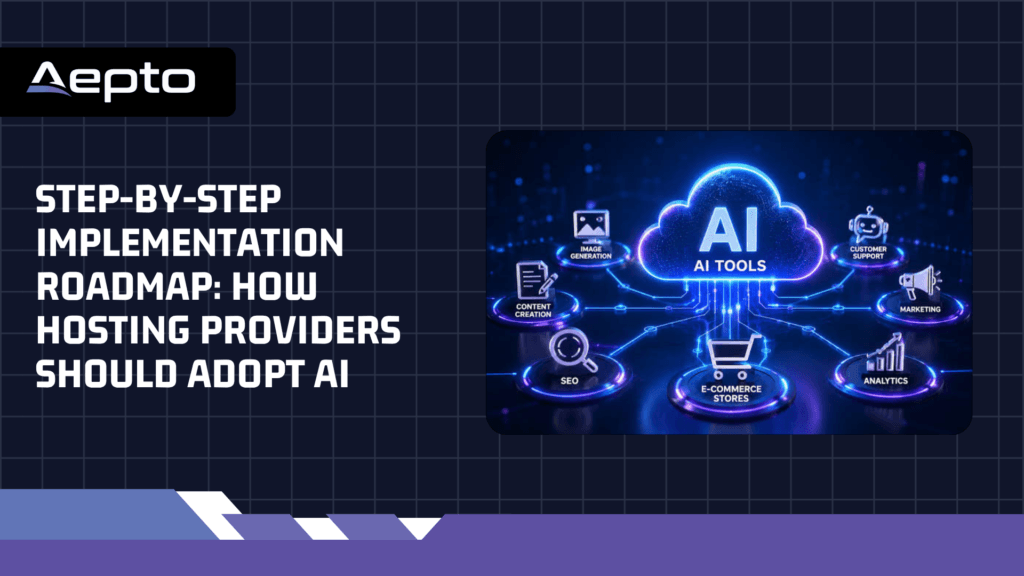
Step-by-Step Implementation Roadmap: How Hosting Providers Should Adopt AI
Integrating artificial intelligence into a web hosting organization requires a structured implementation strategy to ensure data privacy, operational stability, and high ROI.
Phase 1: Security and Support (Months 1–3)
- Deploy AI Security Tools: Implement server-level security suites like Imunify360 across your host nodes to automate malware mitigation immediately.
- Integrate AI Support Assistants: Train an AI knowledge agent (such as Intercom Fin) on your documentation to handle baseline tier-1 customer inquiries.
Phase 2: Monitoring and Infrastructure Optimization (Months 4–6)
- Connect Predictive Monitoring: Implement full-stack telemetry and pair internal metrics with external uptime and domain monitoring via Aepto.
- Optimize Server Density: Deploy resource allocation engines like Granulate to optimize CPU and memory performance across multi-tenant servers.
Phase 3: Analytics, Billing, and Churn Prevention (Months 7–9)
- Deploy Churn Intelligence: Connect billing data (WHMCS, ClientExec, or custom billing panels) to customer health analytics platforms.
- Automate Retention Workflows: Trigger automated promotional discounts, resource upgrades, or priority support tickets when customer health scores drop below thresholds.
Key Challenges and Ethical Considerations When Using AI in Hosting
While AI offers immense advantages, web hosting providers must navigate technical and regulatory challenges during implementation:
- Data Privacy and GDPR Compliance: Ensure that AI models trained on support tickets or server logs do not expose sensitive customer data, API keys, or personally identifiable information (PII) to public LLM APIs.
- Over-Reliance on Automated Support: AI chatbots must always provide an immediate, seamless escalation path to human technical engineers when a customer experiences complex server issues.
- Hallucinations in Technical Diagnostics: Language models can occasionally suggest incorrect command-line scripts or configuration changes. Always restrict AI agents from executing system-level root commands automatically without human validation.
Conclusion: What AI Tools Should Hosting Providers Use
The future of web hosting belongs to autonomous, AI-driven infrastructure. Hosting providers that integrate artificial intelligence into their operations will deliver superior uptime, faster support response times, tighter cybersecurity, and better profit margins than legacy competitors.
By combining AI-powered server security tools (Imunify360), intelligent support automation (Zendesk/Intercom AI), dynamic resource optimization (Densify), and comprehensive external monitoring via Aepto.com, hosting providers can build a resilient, scalable, and highly profitable hosting operation.
Empower your hosting infrastructure with proactive domain health, uptime verification, and DNS monitoring solutions at Aepto.com today!
Frequently Asked Questions (FAQs)
Will AI replace human system administrators in web hosting?
No. AI tools are designed to augment human system administrators, not replace them. AI excels at processing massive volumes of telemetry data, identifying anomalies, and automating routine tier-1 support tasks. Complex server architecture design, kernel debugging, emergency disaster recovery, and high-level infrastructure planning will always require experienced human engineers.
How much can AI support automation reduce web hosting operating costs?
Implementing AI-driven support chatbots and automated ticketing triage can resolve between 40% and 70% of routine client inquiries without human intervention. This drastically reduces support costs, reduces ticket backlog, and allows your engineering team to focus on complex infrastructure projects.
Is AI cybersecurity better than traditional signature-based antivirus software?
Yes. Traditional antivirus software relies on known malware signatures. If a hacker deploys a novel zero-day exploit or custom script, signature scanners will fail to detect it. AI cybersecurity tools analyze script behavior, execution patterns, and network traffic in real time, enabling them to block previously unknown threats instantly.
How does AI improve shared hosting resource density?
In shared hosting environments, allocating fixed hardware resources based on static limits often leaves server capacity unused. AI algorithms analyze real-time usage trends across all hosted accounts, dynamically balancing active PHP processes and MySQL workloads so servers can safely host more clients without performance degradation.
Can small hosting providers afford enterprise AI tools?
Yes. Many AI tools offer flexible pay-as-you-go pricing models tailored for small to mid-sized hosting providers. Additionally, implementing open-source AI models (such as Llama-based local LLMs for support ticket classification) allows smaller hosts to deploy custom AI pipelines with minimal ongoing software licensing fees.
Latest Posts by our blog:
- What AI Tools Should Hosting Providers Use? The Ultimate AI Integration Guide
- Managing Multiple Domain Names Efficiently: Streamlined Digital Asset Management
- Can Someone Buy My Expired Domain? Complete Guide
- What Happens If Someone Steals My Domain? The Complete Impact and Recovery Guide
- How to Monitor Domain Ownership Changes: The Complete Enterprise Guide