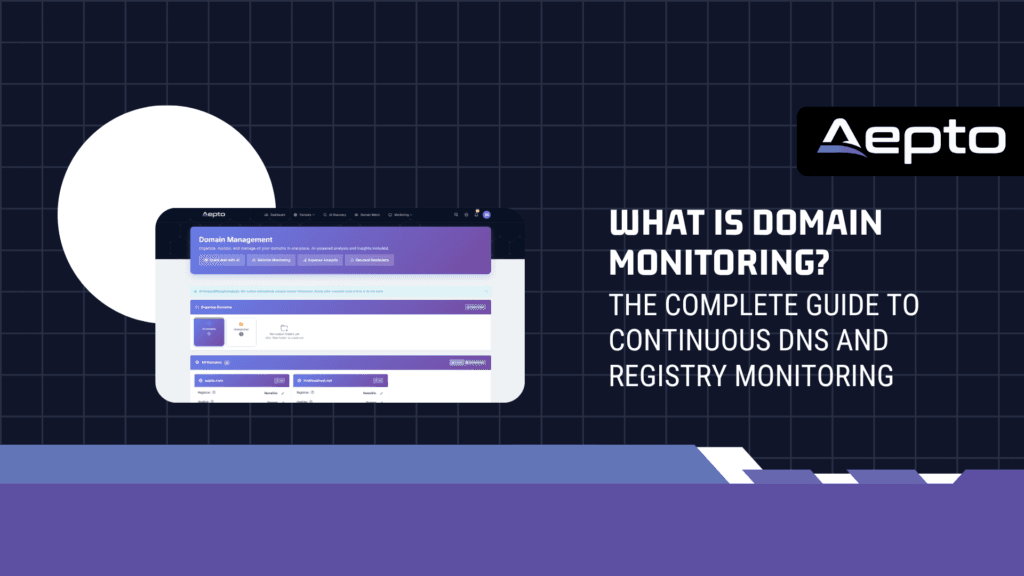
What is Domain Monitoring? In the modern enterprise digital ecosystem, your domain name serves as the absolute center of gravity for your brand. It routes your web traffic, authorizes secure system logins, handles your internal corporate email flows, and establishes your legal trademark identity.
Yet, despite being the single most valuable digital property an organization owns, domain names are routinely left exposed to silent, sophisticated, and highly damaging external exploits.
Traditional cybersecurity suites are designed to defend local corporate networks, server-side codebases, and user endpoints. However, standard firewalls and antivirus programs are completely blind to what occurs on the global Domain Name System (DNS) registry.
If an attacker gains unauthorized access to your registrar credentials, they will not compromise your local server; instead, they will quietly modify your Nameservers, route your traffic to fake servers, or intercept your mail exchanges.
Because these changes happen outside your network, you will receive zero server error warnings. Your first notification of a breach will likely be a severe decline in customer trust, an active data leak, or a security blacklisting.
To secure this boundary, modern businesses must implement a continuous, real-time tracking system known as Domain Monitoring. This comprehensive guide will explore the technical mechanics of Domain Monitoring, the critical security threats it neutralizes, and how deploying an automated watching framework safeguards your digital assets from the registrar registry to your backend server.
Key Takeaways
Before analyzing the technical mechanics of DNS defense, here is an executive summary of why Domain Monitoring is vital:
- Active External Shield: Domain Monitoring acts as an external digital tripwire, monitoring critical DNS registry updates outside your local firewalls.
- Neutralize Nameserver Drifts: Get instantly alerted the moment unauthorized changes are made to your authoritative nameservers or MX records.
- Stop Domain Hijacking: Domain Monitoring tracks EPP registry status codes in real-time, warning you if transfer locks are disabled.
- Comprehensive Integration: Securing your domain pathways must be aligned with high-performance, hardened server hosting.
- Mitigate Human Error: Automated alerts bypass messy personal inboxes to route warnings directly to shared corporate workflows.
1. What is Domain Monitoring?
At its technical foundation, Domain Monitoring is an active, continuous monitoring technology designed to track, audit, and analyze authoritative DNS records, registry status codes, WHOIS databases, and routing configurations.
While traditional security tools are internal, Domain Monitoring sits externally. It queries global root-zone registry servers around the clock, matching live internet configurations against your authorized security baselines.
[ Authoritative Root Registry ] ➔ [ Continuous Domain Monitoring Queries ] ➔ [ Baseline Deviation Detected ] ➔ [ Escalated Multi-Channel Alert ]
When you manage a large inventory of digital names across various registrars, keeping track of manual changes is practically impossible. Unmanaged sprawl quickly leads to severe blind spots. To establish absolute control over this external footprint, businesses rely on centralized domain management to monitor all digital real estate from a single dashboard.
By using an automated viewport, Domain Monitoring acts as a persistent sentinel. If any verified registry baseline is altered—even by a fraction—the system intercepts the drift, calculates the threat severity, and pushes an immediate alert to your security operations center (SOC).
Ready to scale your workflow?
Explore how our latest tools can save you hours of manual work every week.
2. Technical Mechanics: How Domain Monitoring Works
To understand the protective capacity of a Domain Monitoring engine, we must examine the specific technical layers it queries, parses, and audits.
Authoritative Nameserver Auditing
An authoritative nameserver is the physical server that holds the master DNS zone files for your domain (directing web browsers where to go). If an attacker compromises your registrar account, their very first action is typically to replace your authoritative nameservers with their own malicious DNS servers.
- The Watch Loop: Domain Monitoring continuously queries the root registry databases (such as Verisign for
.comand.netdomains) to confirm that your authoritative nameservers point strictly to your verified providers. - If a nameserver drift is detected, the engine flags it as a high-priority incident, allowing your technical team to intercept the hijack before global propagation completes.
EPP Registry Status Tracking
The Extensible Provisioning Protocol (EPP) is the communication language utilized between registrars and the central registry. Every domain name is assigned specific EPP status codes that dictate what actions can be executed on it:
clientTransferProhibited: Prevents unauthorized registrar transfers.clientUpdateProhibited: Blocks modifications to DNS records.clientDeleteProhibited: Prevents accidental deletion of the domain.
If an attacker gains access to your registrar, they must manually disable these locks before moving or altering your domain. Domain Monitoring continuously parses these EPP codes. The exact millisecond any lock is set to “inactive” or removed, the watch engine triggers an alarm, giving you a critical head start to intercept the transfer attempt. To explore how this registry lock tracking prevents high-level hijacking, review our deep-dive on domain protection & theft guard systems.
DNS Zone Record Verification (A, AAAA, CNAME, MX, TXT)
Beyond nameservers and registry-level locks, Domain Monitoring monitors your local DNS zone files. It takes continuous snapshots of your resource records:
- A & AAAA Records: Verifying your domain points exclusively to your authorized hosting IPs.
- MX Records: Auditing your mail exchange servers to prevent attackers from silently routing your corporate emails to unverified servers.
- TXT Records (SPF, DKIM, DMARC): Ensuring your cryptographic email-validation keys have not been tampered with to launch spam or business email compromise (BEC) campaigns.
3. High-Risk Threats Intercepted by Domain Monitoring
Traditional, passive domain administration relies on manual audits. However, cyber threats happen in milliseconds. Domain Monitoring is designed to actively neutralize several highly sophisticated security exploits:
Unauthorized DNS and Nameserver Hijacking
DNS hijacking occurs when an unauthorized entity alters your DNS settings, redirecting legitimate visitors away from your authentic website and routing them to a duplicate phishing landing page. Because your local web server remains fully operational, your local uptime monitoring tools will show no errors. Domain Monitoring acts as the external observer, validating that the global internet is routing users to your correct, authentic IP addresses.
Subdomain Takeover
Many modern organizations point subdomains (such as blog.yourbrand.com or dev.yourbrand.com) to third-party SaaS platforms, cloud buckets, or external hosting services. If you decommission the third-party service but forget to delete the corresponding CNAME record in your DNS, an attacker can register an account on that same SaaS platform, claim your orphaned subdomain, and host malicious content under your trusted brand name. Domain Monitoring audits your zone records, flagging orphaned CNAMEs before they can be exploited.
Stealth DNS Redirection
Some advanced persistent threats (APTs) do not hijack your entire domain. Instead, they implement “stealth redirection” by modifying your DNS records during off-peak hours (such as weekends or holidays) to run temporary, localized phishing campaigns, only to restore the original records before business hours begin. Because Domain Monitoring operates continuously on high-speed API loops, it catches these temporary shifts, preserving the absolute integrity of your digital perimeter. Transitioning to this level of active surveillance is discussed in our AI domain monitoring guide.
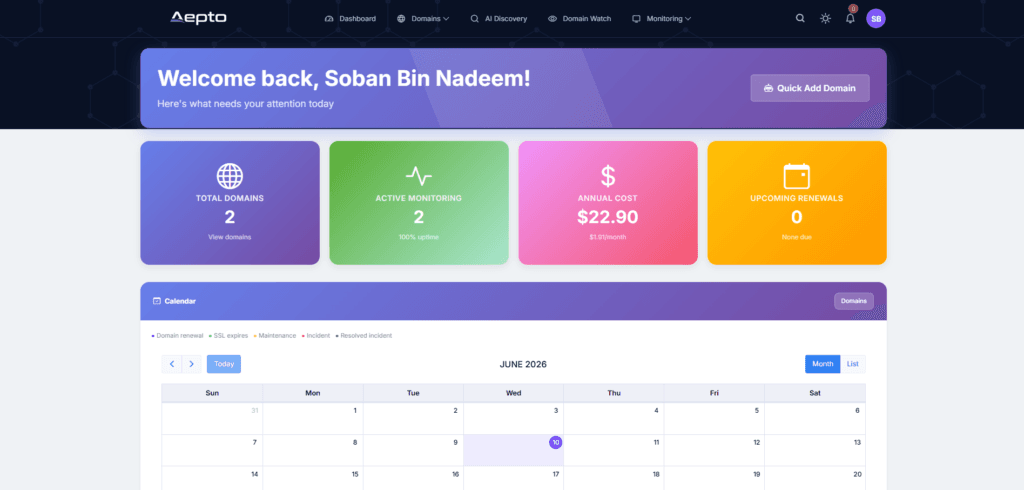
4. The Unified Management View: Aepto Platform Features
If your business manages a diverse inventory of digital names across separate registrars, tracking alerts individually leads to severe dashboard fatigue. To protect your brand effectively, you must utilize an integrated, intelligent Domain Monitoring solution.
By leveraging Aepto’s advanced the art to simplify domain management dashboard, your team can unify its security operations.
THE AEPTO DEFENSE SYSTEM:
[ Multi-Registrar API Ingestion ] ➔ [ Continuous Domain Monitoring Monitoring ] ➔ [ Smart Alerts & Webhooks ]
Real-Time Status Monitoring
Aepto’s Domain Monitoring engine queries authoritative registry-level records continuously. The moment an unexpected status shift, update, or nameserver drift occurs on any of your tracked domains, the system logs the incident, calculates the risk, and initiates your escalation pathways.
Multi-Channel Alerting
Traditional registrar email warnings are easily archived, lost in spam filters, or missed when employees leave the company. Aepto circumvents these single points of failure by implementing smart domain renewal alerts and multi-channel notification rules:
- Alert Webhooks: Route critical domain alerts straight to your active developer and IT channels and automations like n8n.
- SMS & Voice Notifications: Reach designated security directors immediately when critical status shifts (like registry lock disabling) are detected.
- Unified API Feeds: Connect your Domain Monitoring alerts directly to your enterprise Security Information and Event Management (SIEM) dashboard.
5. Security Synergies: Aligning Domain Monitoring with Hardened Hosting
Protecting your brand’s digital legacy requires a defense-in-depth model. While Domain Monitoring secures your external nameservers, registry locks, and DNS routing pathways, your website’s actual files, transactional databases, and system APIs must be hosted on highly secure, performant web servers.
If your domain routing is completely secure but your destination server is slow, vulnerable, or running on outdated hardware, your brand remains exposed. Conversely, hosting your applications with a premier, enterprise-grade provider like Limitless Hosting provides the ultimate structural synergy.
By pairing Aepto’s real-time Domain Monitoring with a hardened, SSD-powered hosting environment, you eliminate security and performance bottlenecks. If your host encounters a node issue or if your domain DNS is accidentally modified, you can verify your live server configurations against your authoritative records in seconds, guaranteeing 100% operational stability for your global audience.
6. Actionable Blueprint: Launching a Professional Domain Monitoring Strategy
To implement a highly resilient Domain Monitoring strategy across your organization, execute this three-step deployment playbook:
Step 1: Discover and Consolidate Your Footprint
Map out all domain assets registered across different departments, regional offices, and external marketing agencies. Import them into your centralized Aepto dashboard to establish a single, audited inventory of your brand’s digital real estate.
Step 2: Establish Your DNS Baselines
Define the authorized nameservers, MX records, and server IP addresses for your core assets. Lock these parameters within your watch interface to establish your trusted digital baseline.
Step 3: Configure Multi-Channel Alert Escalations
Set up escalating notification rules that bypass individual employee inboxes. Route high-priority events (such as nameserver drifts, registry status changes, or impending renewals) directly to shared corporate email addresses and developer communication tools for immediate action.
Aepto’s Domain Monitoring vs. Traditional WHOIS Lookups
| Monitoring Feature | Traditional WHOIS Lookup | Automated Domain Monitoring (Aepto) |
|---|---|---|
| Tracking Frequency | Manual, on-demand queries | Continuous, 24/7 automated sweeps |
| Detection Scope | Basic registrar data points | Full DNS zone files, MX, and EPP locks |
| Alert Delivery | None (requires manual checking) | Real-time Alert Webhooks intergration, and Email |
| Rate-Limit Vulnerability | Highly restricted by public servers | High-speed, private registry API queries |
| Threat Intelligence | Passive data displays | Predictive scoring of potential hijacking |
Conclusion: Securing Your Digital Legacy
In the fast-moving corporate landscape, your domain name portfolio is the literal foundation of your brand’s reputation, digital communications, and customer trust. Relying on passive registrar alerts, manual spreadsheet audits, or fragile auto-renewal mechanisms to protect these high-value digital assets introduces an unnecessary, high-stakes risk to your operations.
By deploying an automated Domain Monitoring framework, establishing rigid DNS baselines, and partnering with high-performance, hardened web hosting, you construct a unified shield around your brand. Take control of your digital perimeter, automate your technical lifecycles, and protect your digital assets with total clarity.
Are you ready to claim absolute control over your digital footprint? Open your Aepto Dashboard today to audit your domain health, activate real-time Domain Monitoring, and secure your digital legacy for the future.
Frequently Asked Questions (FAQs)
1. What is Domain Monitoring, and how does it protect my brand?
Domain Monitoring is an active, continuous security system that monitors your authoritative DNS records, nameservers, registry locks, and MX configurations in real-time. It acts as a digital tripwire, alerting you the instant any unauthorized changes are made to your domain’s global routing settings, protecting you from hijacking and redirection.
2. How does a nameserver drift happen, and why is it dangerous?
Nameserver drift occurs when your domain’s authoritative DNS servers are changed without your authorization, typically due to a compromised registrar account. This allows attackers to redirect your web traffic to lookalike phishing sites and copycat servers, completely bypassing your local server firewalls.
3. Can Domain Monitoring monitor domains across multiple registrars?
Yes. Because Domain Monitoring queries authoritative root-zone registry databases directly using secure protocols, it tracks and audits domains registered anywhere in the world. You do not need to transfer your domains to monitor them; you can keep them with GoDaddy, Namecheap, or Route 53 while using Aepto as your centralized watcher.
4. What is a subdomain takeover, and how does monitoring prevent it?
A subdomain takeover occurs when a subdomain (e.g., test.yourbrand.com) points to an orphaned third-party service that is no longer active. An attacker can register an account on that same service and claim the subdomain to host malicious files. Domain Monitoring audits your zone records to identify and flag these orphaned records.
5. Why should my secure domain point to an enterprise-grade web host?
Securing your domain path is only half the battle; the destination server must be equally secure. Storing your corporate files and web applications with a high-performance host like Limitless Hosting guarantees that your live data is fast, reliable, and secure against server-side exploits.
6. How does Domain Monitoring help prevent accidental domain expiration?
Domain Monitoring continuously monitors your domain’s registry expiration state. If a domain is nearing its expiration date, the platform bypasses cluttered personal email inboxes, routing automated, escalating warnings across shared email channels to ensure your administrative team takes action.
Latest Posts:
- Why Domain Monitoring Is Worth the Investment for Businesses
- How to Reduce the Cost of Monitoring Multiple Domains
- How to Reduce the Cost of Monitoring Multiple Domains
- Aepto Tech Stack Detector Extension: Hosting, CDN & CMS
- Is Domain Protection Worth It? The Definitive Guide to Safeguarding Your Digital Identity