Introduction To Domain Name Management and Renewals For Corporate
In the modern enterprise ecosystem, a corporation’s digital footprint is distributed across cloud networks, geographically dispersed server infrastructures, dynamic application programming interfaces (APIs), and multi-tiered marketing campaigns.
At the absolute center of this vast digital web sits the Domain Name System (DNS). Your corporate domain portfolio is not merely a collection of web addresses; it is the fundamental anchor of your brand’s global identity, its transactional communications, its legal trademarks, and its customer trust.
Despite this critical importance, corporate domain portfolios are frequently treated as administrative afterthoughts. As organizations execute mergers, acquisitions, and regional expansions, their domain assets become fragmented across multiple departments, local marketing agencies, and various registrar portals.
This state of administrative entropy, known as “domain sprawl,” creates massive financial leakages, operational vulnerabilities, and severe security blind spots.
For enterprise-level organizations, knowing how to establish unified governance over these digital assets is a baseline operational necessity.
This comprehensive guide explores the unique challenges of corporate domain management, the severe security risks of administrative drift, and the best practices to secure, manage, and automate your domain renewals using the intelligent framework of Aepto.
Key Takeaways for Corporate Teams
Before exploring deep governance frameworks, here is an executive summary of enterprise domain strategy:
- Centralization is Mandatory: Corporate portfolios scattered across multiple departments and registrars create critical security blind spots. Centralized visibility is the first line of defense.
- The High Cost of Expiration: For a corporation, a domain expiration means immediate brand disruption, email blackout, and catastrophic SEO degradation.
- Leverage Folder-Based Governance: Segment domains by strategic business value to prevent alert fatigue and target high-priority security resources effectively.
- Implement Independent Redundant Alerts: Relying solely on a single registrar’s auto-renew mechanisms introduces a dangerous single point of failure.
- Align Routing with Secure Hosting: Secure DNS routing must terminate at a highly resilient, enterprise-grade web hosting provider to ensure comprehensive digital safety.
The Anatomy of Corporate Domain Sprawl
Unlike small businesses or personal web projects, corporate domain portfolios often consist of hundreds, or even thousands, of distinct domain names. This scale is driven by several operational necessities:
- Defensive Trademark Registrations: Securing brand variations across multiple generic Top-Level Domains (gTLDs) and country-code Top-Level Domains (ccTLDs) to prevent cybersquatting.
- Localized Marketing Campaigns: Launching unique landing pages for temporary product promotions, regional advertisements, or joint ventures.
- Corporate Mergers and Acquisitions (M&A): Inheriting historical domains, brand names, and DNS configurations from newly acquired corporate entities.
Without strict organizational governance, this scale quickly degrades into administrative chaos. In most corporations, there is no single department that “owns” the domain portfolio.
The marketing department registers promotional domains with one registrar; the IT department manages core systems on another; and external design agencies register secondary brands under personal developer accounts.
This fragmentation results in “administrative drift”, a state where the corporation loses track of what domains it owns, where they are registered, who has the administrative credentials, and when they expire. To reclaim control over this chaotic sprawl, corporate teams must master the art to simplify domain management through a single, unified oversight model.
Ready to Upgarde Your Business Strategy?
Explore how our latest tools can save you hours of manual work every week.
Enterprise Vulnerabilities: What is at Stake?
The financial and operational consequences of an unmanaged corporate domain portfolio go far beyond simple website downtime. When a high-value corporate asset is compromised or allowed to expire, the impact is immediately felt across the entire corporate structure.
THE DOMAIN COMPROMISE TRICKLE-DOWN EFFECT:
[ Domain Expiration / Hijacking ]
       ➔ [ Immediate Website and API Blackout ]
       ➔ [ Corporate Email Bounces & Metadata Leaks ]
       ➔ [ Drop-Catchers Claim High-Value Asset ]
       ➔ [ Severe Regulatory Compliance & Trust Penalties ]
The Instant Corporate Email Blackout
Because your MX (Mail Exchanger) records are housed within your domain’s DNS zone, a domain expiration or unauthorized modification instantly shuts down your corporate email network. Incoming client emails will bounce, and outgoing employee communications will fail.
In highly regulated sectors such as finance, healthcare, or legal services, even a 30-minute email blackout can result in millions of dollars in lost transactions, breached service-level agreements (SLAs), and severe reputational damage.
Exploitation via Drop-Catchers and Cybersquatters
When a corporate domain accidentally hits its pending-delete phase, it is targeted by automated drop-catching scripts. These scripts are run by opportunistic investors and malicious actors who attempt to register the domain the exact millisecond it is released back to the public pool.
Once claimed, they can redirect your pre-existing traffic to adult directories, competitor portals, or high-fidelity phishing clones. Buying back a hijacked brand name often requires corporate legal teams to pay tens of thousands of dollars in broker fees or engage in lengthy, expensive ICANN Uniform Domain-Name Dispute-Resolution (UDRP) proceedings.
Regulatory and Compliance Penalties
Under modern global data privacy regulations (such as GDPR, HIPAA, and CCPA), corporations have a strict legal obligation to secure consumer data pathways.
If a domain containing customer portal routing is hijacked due to weak registrar security or administrative neglect, the corporation faces immediate regulatory audits, class-action lawsuits, and heavy financial compliance penalties for failing to secure its data perimeters.
This risk highlights why centralized domain management matters more than ever in an era of strict enterprise compliance.
Designing a Corporate Domain Governance Framework
To protect your enterprise from administrative drift and security failures, your executive team must deploy a structured corporate domain governance framework. This involves establishing clear policies, standardizing registrar footprints, and utilizing centralized software dashboards.
| Governance Pillar | Action Item | Corporate Priority |
|---|---|---|
| 1. Consolidated Footprint | Monitor all external registrars via a single dashboard | High |
| 2. Role-Based Access Control | Restrict administrative and DNS editing permissions | Critical |
| 3. Portfolio Segmentation | Group domains into folders based on business value | High |
| 4. Registry-Level Locks | Enforce transfer and delete blocks on core domains | Critical |
| 5. Financial Auditing | Track annual expenses and ROI per digital asset | Medium |
Step 1: Centralize Without Moving Registrars
Many enterprise IT teams resist consolidation because the physical transfer of thousands of domains between registrars is an operational nightmare that risks DNS downtime. Modern corporate management platforms solve this by offering centralized APIs.
By utilizing platforms that are fully compatible with all domain registrars, corporate security teams can aggregate data streams from GoDaddy, MarkMonitor, Route 53, and CSC Global into a single pane of glass without migrating the underlying domain registrations.
Step 2: Implement Folder-Based Segmentation
A massive corporate portfolio contains domains with radically different business values. Your primary investor relations domain requires a vastly different security posture than a temporary promotional landing page.
By deploying domain folder management, you can organize your assets into logical groupings based on department, country, client, or priority level. This allows you to apply strict, automated security policies to your “Core Assets” folder while keeping your “Defensive Trademark” folder lean and cost-efficient.
Automating Enterprise Renewals and Alert Escalations
Relying on registrar auto-renewal systems is a major single point of failure for enterprise portfolios. If a corporate purchasing card is cancelled due to fraud, or if a billing department restructure delays a invoice approval, the auto-renewal will fail, sending your core assets into the expiration cycle.
To ensure continuous uptime, corporate portfolios must rely on independent, registry-level, multi-channel alerting systems.
Multi-Channel Escalation Pathways
Generic renewal emails sent to a single employee’s inbox are easily lost, archived, or completely missed if that employee is out of the office or leaves the company. This communication failure is one of the common domain mistakes that cost businesses traffic and revenue.
Aepto’s smart domain renewal alerts bypass individual inboxes by querying authoritative registry zone servers directly. If an asset is approaching its expiration date, our cognitive engine triggers an escalating chain of notification events across corporate channels:
- Level 1 (90 Days Out): Daily dashboard updates and automated email digests pushed to a shared corporate team inbox (e.g.,
domains@company.com). - Level 2 (30 Days Out): Structured webhook notifications pushed directly to the engineering and IT team’s Slack, Microsoft Teams, or Jira project boards.
- Level 3 (7 Days Out – Critical): Automated SMS alerts and phone calls routed directly to designated system administrators and security directors.
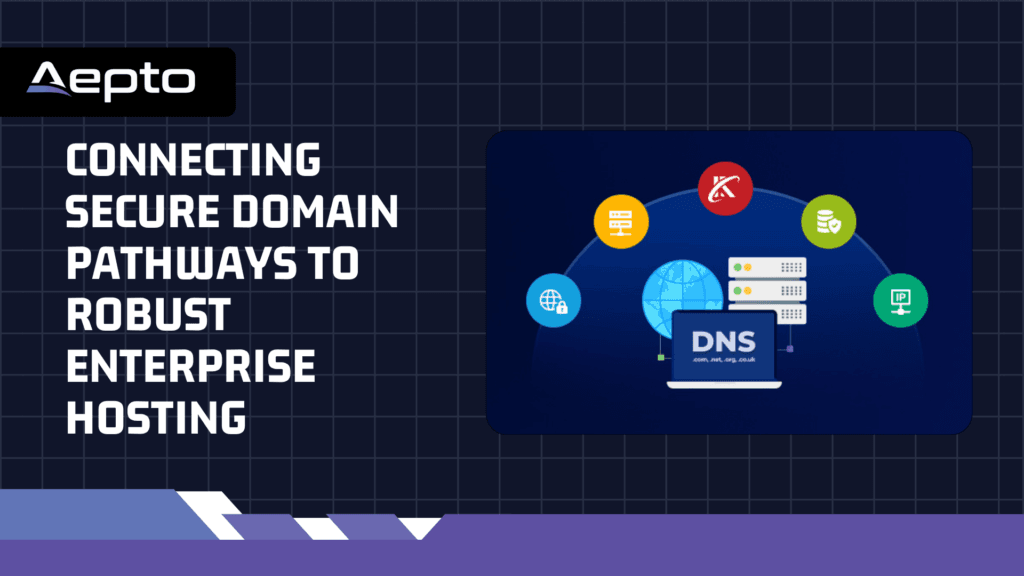
Connecting Secure Domain Pathways to Robust Enterprise Hosting
A domain name cannot function in isolation; it exists to route global traffic to your live web applications and corporate files. Therefore, your external domain security must align perfectly with your underlying web hosting infrastructure.
If your external DNS routes are secure but your backend servers are unpatched, slow, or hosted on brittle hardware, your digital operations remain highly vulnerable. Conversely, hosting your website databases, APIs, and microservices on an enterprise-grade, SSD-powered infrastructure like Limitless Hosting provides the ultimate defense-in-depth model.
While Aepto’s advanced domain-level watchers protect your external nameservers, registry locks, and WHOIS integrity from hijacking, Limitless Hosting ensures your live code is fast, secure, and fully isolated from multi-tenant vulnerabilities.
By linking intelligent domain alerts with highly optimized server environments, you eliminate technical gaps. If your hosting environment encounters a sudden localized node issue, or if your external DNS records are modified by an unauthorized third party, the unified tracking allows your engineering team to detect the failure point in seconds and restore operations immediately.
Financial Optimization: Domain Expense and ROI Auditing
A corporate domain portfolio represents a significant annual financial investment. As companies accumulate thousands of defensive trademark registrations, domain renewal fees can quietly grow into a massive annual cost center. To maintain financial efficiency, corporate teams must actively audit their spending.
By utilizing advanced software to visualize your digital balance sheets, you can run detailed cost-benefit analyses across your entire inventory. Applying domain expense roi tracking tools allows your financial officers to:
- Identify underperforming, secondary domains that generate zero referral traffic or brand search impressions.
- Flag redundant geographic registrations that can be safely dropped or consolidated to save on annual fees.
- Predict upcoming fiscal renewal surges, preventing cash-flow bottlenecks and ensuring your primary strategic assets are always funded.
Conclusion: Transitioning to Enterprise-Grade Control
In the high-stakes digital landscape, your domain names are the literal keys to your corporate kingdom. Relying on legacy, spreadsheet-based tracking, outdated WHOIS contact information, or single-point-of-failure corporate credit cards to protect these assets is a massive operational risk.
By implementing a centralized governance framework, configuring folder-based segmentation, deploying independent registry-level alerts, and choosing highly secure backend web hosting, you create an impenetrable digital perimeter. Take back control of your brand’s digital legacy, automate your technical lifecycles, and protect your digital assets with total clarity.
Are you ready to secure your corporate digital perimeter? Open your Aepto Dashboard today to audit your domain portfolio, configure your automated watchlists, and secure your digital assets for the next decade.
Frequently Asked Questions (FAQs)
1. Why is corporate domain management more complex than standard domain management?
Corporate domain portfolios are significantly larger, often containing hundreds of defensive trademarks and regional ccTLDs. They are frequently managed by fragmented departments (Marketing, IT, Legal) across multiple registrars, leading to high administrative overhead, security gaps, and a higher risk of accidental expirations.
2. What is a registry-level lock, and why is it critical for corporate domains?
A registry lock (such as registryTransferProhibited) is an ultra-secure lock applied directly at the central registry level (e.g., Verisign for .com domains). Unlike a standard registrar lock, a registry lock cannot be removed automatically by compromised registrar credentials.
It requires manual, multi-factor verification between the registry and authorized corporate officers, preventing high-level hijacking attempts.
3. How does Aepto monitor domains registered across different providers?
Aepto queries authoritative root-zone registry servers directly using secure WHOIS and DNS protocols. Because our monitoring engine pulls data straight from the root source rather than relying on a single registrar’s API, we can track, audit, and alert you on domains registered anywhere in the world, making our platform compatible with all registrars.
4. What are the legal risks if a corporate domain accidentally expires?
If a corporate domain expires and is claimed by an opportunistic drop-catcher, they can host malicious software, distribute phishing pages, or harvest emails intended for your company.
This can lead to massive trademark infringements, loss of client trust, and severe regulatory audits and compliance fines under GDPR or HIPAA for failing to secure customer data pathways.
5. Why should corporate teams use Blesta for hosting and billing automation?
For corporations that run private hosting clouds or manage client websites, manual billing is incredibly inefficient. Automated invoicing systems like Blesta integrate seamlessly with web server APIs and credit card gateways, automating provisioning, billing cycles, and payment collections while keeping operational margins extremely lean.
6. How does enterprise hosting complement my domain protection?
Domain protection ensures that users are routed to the correct server IP. However, if that destination server is slow or vulnerable, your operations remain at risk.
Storing your corporate files and web applications with an enterprise-grade host like Limitless Hosting guarantees that your live data is fast, reliable, and secure against server-side exploits.
Read our latest posts: