A domain name is more than a web address. For most businesses, it is part of the brand identity, a gateway to customers, an email communication channel, and an important digital asset. If a business loses control of a domain, fails to renew it on time, or misses a critical change to its DNS configuration, the consequences can range from temporary downtime to serious financial and reputational damage.
This is why domain monitoring has become an increasingly important part of modern business security and digital asset management.
Domain monitoring continuously watches important information associated with a domain and alerts businesses when something changes. Depending on the monitoring solution, this can include domain expiration dates, DNS records, SSL certificates, nameservers, registrar information, domain status, and other potentially important changes.
For businesses managing one domain or hundreds of domains, automated monitoring can provide visibility that manual checking simply cannot match.
In this guide, we will explain why businesses need domain monitoring, what risks it helps prevent, which domains should be monitored, and how companies can build a practical domain monitoring strategy.
What Is Domain Monitoring?
Domain monitoring is the process of continuously tracking a domain name and its associated infrastructure for important changes, risks, and events.
Instead of relying on someone to manually check a domain every few weeks or months, monitoring software can automatically inspect relevant domain information and notify the appropriate people when something requires attention.
Depending on the platform, domain monitoring may track:
- Domain expiration dates
- Renewal status
- DNS record changes
- Nameserver changes
- Registrar changes
- Domain status changes
- SSL certificate expiration
- SSL certificate changes
- Website availability
- WHOIS-related information
- Suspicious domain activity
- Configuration changes
- Brand-related domains
- Newly registered lookalike domains
This makes domain monitoring particularly valuable for organizations where domains are considered critical business assets.
Businesses can also use dedicated domain monitoring software to centralize visibility across multiple domains rather than depending on spreadsheets, calendar reminders, or manual checks.
Why Do Businesses Need Domain Monitoring?
Businesses need domain monitoring because domain-related problems can occur without warning, and many of them can directly affect revenue, security, communications, and customer trust.
Consider what could happen if a company’s primary domain expires.
The website could become unavailable. Business email accounts could stop functioning. Customers might be unable to access important services. Marketing campaigns could direct users to an inaccessible website. In certain situations, the expired domain could eventually become available for registration by another party.
A simple renewal oversight could therefore become a major business incident.
Domain monitoring helps businesses identify these risks earlier and gives teams time to respond.
1. Prevent Accidental Domain Expiration
One of the most important reasons businesses use domain monitoring is to prevent accidental domain expiration.
Domains are normally registered for specific periods and must be renewed to remain under the organization’s control. Companies with multiple domains can easily lose track of individual renewal dates.
This becomes even more complicated when:
- Different domains are registered with different registrars.
- Domains have different expiration dates.
- Multiple employees manage domain assets.
- Registration accounts are spread across departments.
- Domains were acquired through mergers or acquisitions.
- Former employees controlled registrar accounts.
- Renewal emails are missed or sent to outdated addresses.
A business might have dozens, hundreds, or even thousands of domains. Manually remembering every renewal date is unreliable.
Automated expiration monitoring provides another layer of protection by tracking renewal deadlines and notifying responsible teams before an important domain expires.
For organizations building a larger domain portfolio, understanding how to find out when domains expire can also help establish better domain management processes.
2. Protect Business Email
Domain monitoring is not only about websites.
Business email frequently depends on the company’s domain. Addresses such as sales@example.com, support@example.com, and admin@example.com are critical communication channels.
If the underlying domain experiences an expiration or DNS problem, email services can also be disrupted.
This can affect:
- Customer support
- Sales communications
- Password resets
- Internal communications
- Transactional emails
- Invoices
- Account notifications
- Business partnerships
For some companies, losing email functionality for even a few hours can create serious operational problems.
Monitoring important domain and DNS changes can help teams detect potential issues before they become prolonged communication failures.
3. Detect Unauthorized DNS Changes
DNS is one of the most important components of a website’s infrastructure.
DNS records tell the internet where different services associated with a domain should be directed. Changes to DNS records can therefore have significant consequences.
For example, an unauthorized change could redirect a domain toward infrastructure controlled by an attacker.
Potentially sensitive DNS changes include:
- A record modifications
- AAAA record modifications
- MX record changes
- CNAME changes
- TXT record changes
- Nameserver changes
- DNSSEC-related changes
Not every DNS change is malicious. Businesses regularly update DNS when migrating hosting providers, configuring email services, launching applications, or adding third-party platforms.
The challenge is distinguishing expected changes from unexpected changes.
Domain monitoring can help by notifying administrators when important records change, allowing them to investigate quickly.
4. Reduce the Risk of Domain Hijacking
Domain hijacking occurs when an unauthorized party gains control of a domain or manipulates its registration or configuration.
The consequences can be severe.
An attacker who obtains control of a valuable business domain could potentially:
- Redirect website visitors.
- Disrupt website availability.
- Interfere with email.
- Redirect customers to fraudulent pages.
- Damage brand reputation.
- Attempt phishing campaigns.
- Modify DNS settings.
- Hold the domain for ransom.
Monitoring does not replace strong registrar security, multi-factor authentication, access controls, and proper account management.
Instead, it adds an important detection layer.
If a domain’s registrar, nameserver, or other critical information changes unexpectedly, an alert can give the business an opportunity to investigate before the situation becomes more damaging.
5. Protect Brand Reputation
A company’s domain portfolio can extend beyond its primary website.
Businesses may own:
- Brand domains
- Product domains
- Geographic domains
- Campaign domains
- Defensive domains
- Short domains
- Redirect domains
- Legacy domains
- Domains acquired through mergers
Some organizations also need to monitor domains that they do not own.
Why?
Because malicious actors can register domains that look similar to legitimate brands.
For example, an attacker might register a domain using:
- A misspelled company name
- Additional words
- Hyphenated variations
- Similar-looking characters
- Alternative top-level domains
These domains can potentially be used for phishing, impersonation, fraudulent advertising, or other malicious activities.
Monitoring brand-related domains can help security and marketing teams discover suspicious registrations earlier.
6. Detect Phishing and Impersonation Domains
Phishing attacks frequently depend on convincing users that they are interacting with a legitimate company.
A fake domain can make a fraudulent website appear more credible.
Imagine a customer receives an email directing them to a domain that looks almost identical to a bank, SaaS provider, ecommerce store, or hosting company.
The customer may not immediately recognize the difference.
Domain monitoring can support brand protection by identifying suspicious domains associated with a company’s name or trademarks.
Once a suspicious domain is detected, the organization can investigate it and determine whether additional action is necessary.
This is particularly important for:
- Banks
- Ecommerce businesses
- SaaS companies
- Hosting providers
- Financial services
- Healthcare organizations
- Government-related organizations
- Large consumer brands
The larger and more recognizable the brand, the greater the incentive for attackers to impersonate it.
7. Monitor SSL Certificate Expiration
SSL certificates are another important part of website availability and security.
When an SSL certificate expires, browsers can display security warnings to visitors. Depending on the application and infrastructure, an expired certificate can also interrupt APIs, integrations, mobile applications, and other services.
Certificate monitoring can help businesses identify upcoming expiration dates before they become incidents.
A good monitoring strategy can track:
- Certificate expiration dates
- Certificate issuer
- Certificate changes
- Certificate validity
- Certificate mismatches
- Newly issued certificates
This is particularly useful for companies managing multiple websites, subdomains, applications, and environments.
Businesses should also understand the technical role of certificates by learning what an SSL certificate chain is.
8. Improve Website Uptime and Availability
A domain is often the first point of interaction between a customer and a business.
If the domain stops resolving correctly, the website may become inaccessible even when the underlying web server is functioning.
This creates an important distinction:
Server monitoring tells you whether your infrastructure is operating. Domain monitoring helps tell you whether your domain and related configuration are operating correctly.
Both can be valuable.
For example, a website outage could result from:
- A hosting server failure.
- A DNS configuration error.
- An expired domain.
- A nameserver problem.
- An expired SSL certificate.
- An incorrect DNS record.
- A registrar-related issue.
Without appropriate monitoring, businesses may discover these problems only after customers report them.
9. Manage Large Domain Portfolios
Domain management becomes increasingly difficult as an organization grows.
A small business might have one primary domain.
A growing company could have:
- Main corporate domain
- Country-specific domains
- Product domains
- Campaign domains
- Support domains
- Microsites
- Redirect domains
- Acquired domains
- Defensive registrations
At this point, spreadsheets and calendar reminders become difficult to maintain.
Domain monitoring provides centralized visibility.
Instead of asking employees to remember individual renewal dates and configuration changes, businesses can establish automated monitoring across their entire domain portfolio.
This can significantly reduce administrative overhead.
10. Support Mergers and Acquisitions
Domain assets are easy to overlook during mergers and acquisitions.
When one company acquires another, the acquired organization may have domains registered across multiple registrars and accounts.
Some domains may not be actively used but could still have strategic value.
A domain inventory should ideally identify:
| Domain Asset | Why It Matters |
|---|---|
| Primary website | Core online presence |
| Email domain | Business communication |
| Product domains | Product identity |
| Redirect domains | Traffic and SEO |
| Geographic domains | Regional operations |
| Legacy domains | Existing customers and links |
| Defensive domains | Brand protection |
| Campaign domains | Marketing activities |
Monitoring these domains after an acquisition can help prevent unexpected expiration, configuration problems, or loss of ownership.
11. Reduce Dependence on Manual Checks
Manual domain management is vulnerable to human error.
Employees can forget renewal dates. Emails can be overlooked. Spreadsheets can become outdated. Responsibilities can change when employees leave the company.
Automation reduces these dependencies.
Instead of asking:
“Did someone check this domain?”
A business can establish a monitoring system that continuously checks important domain information.
That shift—from periodic manual checks to continuous monitoring—is one of the biggest advantages of domain monitoring.
Domain Monitoring vs. Manual Domain Management
The difference becomes clear when comparing the two approaches.
| Feature | Manual Management | Automated Domain Monitoring |
|---|---|---|
| Expiration tracking | Periodic | Continuous |
| DNS changes | Usually manual | Automated detection |
| SSL monitoring | Manual checks | Automated alerts |
| Large portfolios | Difficult | Scalable |
| Human error | Higher risk | Reduced |
| Suspicious changes | May be missed | Faster detection |
| Alerting | Calendar/email reminders | Automated notifications |
| Historical visibility | Often limited | Can be centralized |
| Response time | Depends on discovery | Faster |
Manual management can work for a small portfolio, but the risk increases as the number and importance of domains grow.
Which Businesses Should Use Domain Monitoring?
Almost any organization that relies on a domain can benefit from monitoring.
However, it becomes especially valuable for businesses where online availability and brand reputation directly affect revenue.
Ecommerce Businesses
Online stores depend heavily on domain availability.
If customers cannot reach the store, sales can stop.
Monitoring can help ecommerce businesses detect expiration, DNS issues, SSL problems, and suspicious domain activity.
SaaS Companies
SaaS businesses often operate multiple domains and subdomains for:
- Applications
- Documentation
- APIs
- Customer portals
- Authentication
- Marketing websites
A domain problem can affect both customers and internal operations.
Hosting Companies
Hosting providers manage large numbers of customer-facing domains and infrastructure endpoints.
Domain monitoring can complement server and infrastructure monitoring by providing visibility into domain-level changes.
Businesses can also benefit from understanding how AI is impacting web hosting as automation increasingly becomes part of infrastructure management.
Financial Services
Banks, payment companies, and financial platforms are attractive targets for phishing and impersonation.
Monitoring suspicious domains can support broader brand protection and cybersecurity programs.
Marketing Agencies
Agencies often manage domains on behalf of multiple clients.
A centralized monitoring solution can help agencies track expiration dates and important changes across multiple client portfolios.
Enterprises
Large organizations may have hundreds or thousands of domains spread across departments, subsidiaries, countries, and brands.
At this scale, automated monitoring becomes much more practical than manual management.
What Should Businesses Monitor?
A comprehensive domain monitoring strategy should go beyond expiration dates.
Important monitoring categories can include:
Domain Registration
Monitor:
- Registration status
- Expiration date
- Registrar
- Registration changes
- Domain status
DNS Infrastructure
Monitor:
- A records
- AAAA records
- MX records
- CNAME records
- TXT records
- Nameservers
- DNSSEC configuration
SSL/TLS
Monitor:
- Certificate expiration
- Certificate validity
- Certificate changes
- Certificate issuer
- Certificate mismatches
Brand Protection
Monitor:
- Similar domains
- Misspelled domains
- Lookalike domains
- Newly registered brand-related domains
- Potential impersonation domains
Website Availability
Monitor:
- DNS resolution
- HTTP availability
- HTTPS availability
- Response status
- Certificate errors
The exact monitoring capabilities will vary between platforms, so businesses should select a solution based on their domain portfolio and security requirements.
How AI Can Improve Domain Monitoring
Traditional monitoring systems rely heavily on predefined rules.
For example:
Alert me 30 days before a domain expires.
That is useful, but modern domain portfolios can generate a large amount of information.
Artificial intelligence can help analyze that information and identify patterns that deserve attention.
An AI-powered domain monitoring system can potentially help businesses prioritize events rather than treating every change equally.
For example, an ordinary DNS update performed during a scheduled migration may be expected.
An unexpected nameserver change combined with other unusual domain activity could deserve much more immediate attention.
AI can therefore add an intelligence layer to domain monitoring by helping organizations move from simple notification toward contextual risk detection.
Businesses interested in the practical application of AI can also explore how to use AI for domain monitoring.
How to Build a Business Domain Monitoring Strategy
Implementing domain monitoring does not have to be complicated.
Step 1: Create a Complete Domain Inventory
Start by identifying every domain owned or managed by the business.
Include:
- Active domains
- Inactive domains
- Redirect domains
- Product domains
- Regional domains
- Legacy domains
- Defensive registrations
Do not assume the company’s primary domain is the only important asset.
Step 2: Identify Critical Domains
Not every domain has the same business impact.
Classify domains according to importance.
For example:
Critical: Main website, customer portal, business email.
High: Product websites, regional websites, payment-related domains.
Medium: Marketing campaigns and secondary properties.
Low: Legacy or rarely used domains.
This helps teams prioritize alerts.
Step 3: Monitor Expiration Dates
Set automated monitoring for every important domain.
Create alerts early enough to provide sufficient time for renewal and escalation.
Avoid relying solely on the registrar’s renewal emails.
Step 4: Monitor DNS and Nameserver Changes
Unexpected DNS changes should trigger notifications so administrators can verify whether they were authorized.
This is particularly important for critical domains.
Step 5: Monitor SSL Certificates
Track certificate expiration and configuration changes across important domains and subdomains.
Step 6: Monitor Brand-Related Domains
Identify suspicious domains that could be used for impersonation or phishing.
Step 7: Establish an Incident Response Process
Monitoring is only useful when someone responds to alerts.
Define:
- Who receives alerts?
- Who validates changes?
- Who can access the registrar?
- Who handles suspected compromise?
- Who communicates with customers?
- How are incidents documented?
A monitoring system should become part of the organization’s broader security and operational workflow.
What Happens Without Domain Monitoring?
Businesses often discover the value of monitoring only after something goes wrong.
Without monitoring, a company may experience:
- Unexpected domain expiration
- Website downtime
- Email disruption
- DNS misconfiguration
- SSL expiration
- Unauthorized configuration changes
- Phishing domain registration
- Brand impersonation
- Revenue loss
- Customer complaints
- Emergency recovery work
The problem is not simply that something can go wrong.
The bigger issue is how long it takes to discover that something has gone wrong.
A business that detects a domain problem immediately has significantly more options than one that discovers it after customers, employees, or search engines report the issue.
The Business Value of Domain Monitoring
Domain monitoring should not be viewed simply as another technical tool.
It is a form of digital asset protection.
A business invests heavily in its:
- Brand
- Website
- Customer relationships
- Search visibility
- Email infrastructure
- Online applications
- Digital marketing
- Domain portfolio
The domain connects many of these assets together.
Protecting it therefore supports broader business continuity.
For example, preventing a domain expiration may avoid an outage. Detecting an unauthorized DNS change may help prevent traffic redirection. Identifying a suspicious lookalike domain may allow a security team to investigate potential phishing activity earlier.
The value comes from reducing uncertainty and improving response time.
Domain Monitoring Is About Visibility, Not Just Alerts
One common misconception is that domain monitoring is simply a collection of reminder emails.
Modern monitoring can be much broader.
The real objective is to create visibility across the business’s domain ecosystem.
A useful monitoring solution should help answer questions such as:
- Which domains do we own?
- Which domains are approaching expiration?
- Which DNS records changed recently?
- Which certificates are about to expire?
- Which domains are associated with our brand?
- Did a critical domain change unexpectedly?
- Which alerts require immediate attention?
- Who should investigate the event?
When domain information is centralized, organizations can make faster and more informed decisions.
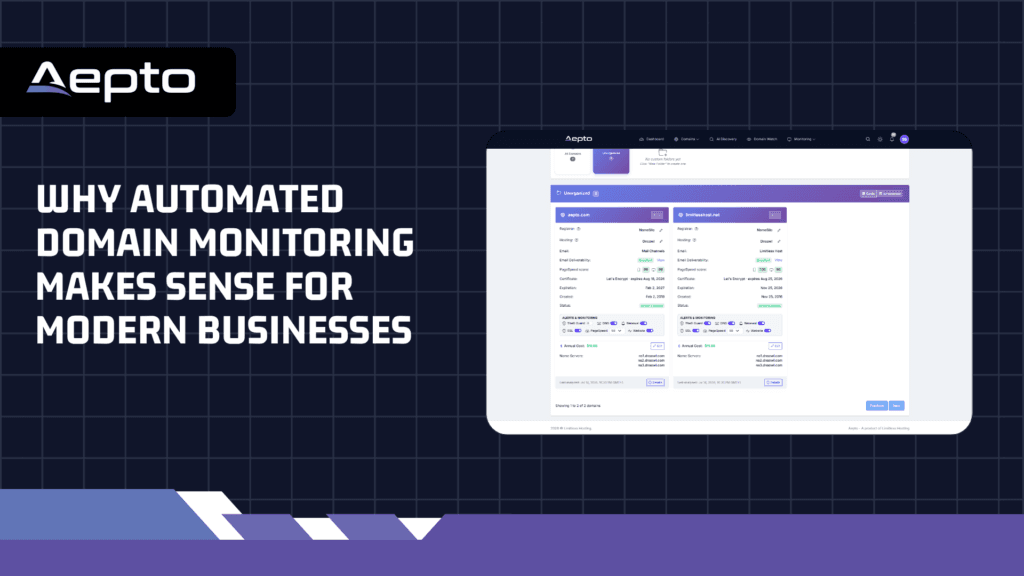
Why Automated Domain Monitoring Makes Sense for Modern Businesses
The internet is now deeply connected to everyday business operations.
A domain can represent:
- A storefront
- A SaaS application
- A support portal
- A payment platform
- A corporate identity
- An email system
- A marketing channel
- A customer authentication endpoint
As businesses become more dependent on digital infrastructure, protecting domains becomes increasingly important.
Manual monitoring may be sufficient for a single low-risk domain.
For organizations managing multiple critical domains, automated monitoring provides a more scalable approach.
It can continuously watch important domain information, detect changes, and bring potential problems to the attention of the right people.
Conclusion
Why do businesses need domain monitoring? Because domains are critical digital assets, and problems involving them can directly affect website availability, email, cybersecurity, brand reputation, and revenue.
Domain monitoring helps businesses stay ahead of issues such as:
- Accidental domain expiration
- DNS configuration changes
- Unauthorized nameserver changes
- SSL certificate expiration
- Domain hijacking
- Phishing and impersonation
- Large-scale domain portfolio management
- Website availability problems
The most important advantage is visibility. Instead of discovering a problem after customers report it, businesses can receive alerts when important changes occur and investigate them sooner.
As domain portfolios become larger and online infrastructure becomes more complex, automated and intelligent domain monitoring is becoming an important component of modern digital asset management.
For businesses that depend on their online presence, monitoring a domain should be treated as seriously as monitoring the infrastructure behind it.
Frequently Asked Questions
1. What is domain monitoring?
Domain monitoring is the continuous tracking of domain-related information such as expiration dates, DNS records, nameservers, SSL certificates, registration information, and potentially suspicious domain activity. It helps businesses identify important changes and potential risks before they cause significant problems.
2. Why is domain monitoring important for businesses?
Domain monitoring is important because a domain can be connected to a company’s website, email, applications, marketing, and brand identity. Monitoring helps businesses detect expiration risks, DNS changes, SSL issues, unauthorized modifications, and suspicious domains that could be used for phishing or impersonation.
3. Can domain monitoring prevent domain expiration?
Domain monitoring cannot physically renew a domain unless the solution provides an automated renewal capability and the appropriate registrar integration. However, it can track expiration dates and provide advance alerts, giving businesses enough time to renew important domains and avoid accidental expiration.
4. Can domain monitoring detect phishing domains?
Some domain monitoring solutions can identify newly registered or suspicious domains that resemble a company’s brand. This can help security and brand protection teams investigate potential phishing or impersonation campaigns earlier.
5. Should small businesses use domain monitoring?
Yes. Even a small business may rely on one domain for its website, email, customer communications, and marketing. While large companies typically have more complex monitoring requirements, small businesses can also benefit from automated expiration, DNS, SSL, and availability monitoring.
6. What should a business monitor besides domain expiration?
Businesses should consider monitoring DNS records, nameservers, SSL certificates, domain status, website availability, registration information, and suspicious brand-related domains. The most appropriate monitoring scope depends on how the business uses its domains.
7. Is AI useful for domain monitoring?
AI can make domain monitoring more intelligent by helping analyze large volumes of domain-related events and prioritize potentially important changes. Instead of treating every event equally, AI-based monitoring can help businesses focus attention on unusual or potentially risky activity.
Read More:
- How Businesses Can Save Money on Domain Monitoring: A Practical Guide
- How to Use Discounts for Monitoring Multiple Websites
- What Should Businesses Monitor Besides Domain Expiration?
- Why Do Businesses Need Domain Monitoring? A Complete Guide
- AI for Network Security and Monitoring: The Comprehensive Guide