Domain expiration is one of the most obvious risks businesses face when managing their online assets. A forgotten renewal can take a website offline, disrupt email services, or even put a valuable domain name at risk.
However, domain expiration is only one part of effective domain monitoring. Other than that, What Should Businesses Monitor Besides Domain Expiration?
Modern businesses depend on a much larger digital infrastructure. DNS records, SSL certificates, website uptime, domain ownership, content, nameservers, security settings, and even newly registered lookalike domains can affect a company’s online presence.
This is why businesses should take a broader approach to domain monitoring and digital asset protection.
Instead of asking only, “When does my domain expire?”, businesses should also ask:
Is my domain secure, reachable, correctly configured, and still representing my brand?
In this guide, we’ll explore what businesses should monitor besides domain expiration and how automated monitoring can help detect problems before they become expensive incidents.
Why Is Monitoring More Than Domain Expiration Important?
A domain can remain active while something else goes wrong.
For example, your domain may not expire for another year, but its SSL certificate could expire tomorrow. Your website could also experience downtime, DNS records could be changed unexpectedly, or someone could register a confusingly similar domain and use it for phishing.
These issues can affect:
- Website availability
- Customer trust
- Email delivery
- Brand reputation
- Cybersecurity
- Search engine visibility
- Online revenue
- Business continuity
For businesses with dozens, hundreds, or thousands of domains, manually checking every asset is extremely difficult.
A comprehensive domain monitoring strategy should therefore track the entire digital ecosystem surrounding a domain rather than expiration dates alone.
Ready to scale your Domain Monitoring?
Explore how our AI Domain Monitoring System can save you hours of manual work every week.
1. Domain Ownership and Registration Changes
One of the most important things businesses should monitor is domain ownership. Unauthorized changes to domain registration information can be a serious security warning. If an attacker gains access to a registrar account, they may attempt to modify ownership information, transfer the domain, or change important account settings.
Businesses should monitor for:
- Registrant changes
- Registration status changes
- Domain transfer activity
- Registrar changes
- Unexpected WHOIS information changes
- Domain lock status
- Nameserver changes
Unexpected ownership or registration changes should trigger an immediate investigation.
For organizations managing valuable brand domains, monitoring ownership changes can provide an additional layer of protection against domain theft.
2. DNS Record Changes
DNS is effectively the routing system behind your domain.
A business may have a perfectly active domain, but an incorrect DNS record can still make its website, email, or other services unavailable.
Businesses should monitor important DNS records, including:
- A records
- AAAA records
- CNAME records
- MX records
- TXT records
- NS records
- SPF records
- DKIM-related records
- DMARC records
Unexpected DNS modifications can sometimes indicate configuration mistakes or unauthorized access.
For example, changing an MX record could interfere with business email, while changing an A record could redirect visitors somewhere they were never supposed to go. DNS monitoring helps businesses identify these changes quickly. Businesses looking to strengthen this area can also explore AI DNS Protection as part of a broader domain security strategy.
3. SSL Certificate Expiration
SSL certificates are another critical asset businesses should monitor.
A domain can be active and fully renewed while its SSL certificate expires.
When that happens, browsers may display security warnings to visitors. Depending on the website, Web Hosting and configuration, customers may hesitate to continue browsing or completing transactions.
Businesses should monitor:
- SSL certificate expiration dates
- Certificate validity
- Certificate issuer
- Certificate changes
- Certificate chain problems
- HTTPS availability
SSL monitoring is particularly important for:
- E-commerce websites
- SaaS platforms
- Banking and financial services
- Customer portals
- Login systems
- Business websites
- API endpoints
Businesses can learn more about continuous certificate monitoring through How to Continuously Monitor SSL Certificates.
4. Website Uptime and Availability
A domain may be registered correctly, secured with SSL, and configured properly while the actual website is still offline.
That’s why website uptime monitoring should be part of every business’s monitoring strategy.
Uptime monitoring can detect:
- Website downtime
- Server connectivity problems
- HTTP errors
- Slow responses
- DNS resolution failures
- SSL connection failures
- Regional availability issues
Even a short outage can affect sales, leads, customer support, and brand credibility. For businesses that rely heavily on their websites, continuous monitoring is much more effective than discovering downtime through a customer complaint. See Smart Global Uptime Monitoring to learn how continuous availability monitoring can fit into a broader monitoring strategy.
5. Website Content Changes
Businesses should also monitor important website content. This is especially useful for high-value pages such as:
- Homepage
- Pricing pages
- Login pages
- Checkout pages
- Product pages
- Terms and conditions
- Contact pages
- Important landing pages
Unexpected content changes could result from a compromised website, an accidental deployment, or an unauthorized modification.
For example, if a pricing page suddenly changes or a malicious script is inserted into a page, traditional domain expiration monitoring will not detect the problem. AI-driven website content monitoring can provide an additional layer of visibility by identifying meaningful changes across important website pages.
6. Domain Ownership Security
Domain theft can be significantly more damaging than simply forgetting a renewal.
A stolen domain can potentially be used to:
- Redirect website visitors
- Intercept business email
- Impersonate a company
- Launch phishing campaigns
- Damage brand reputation
- Disrupt online services
Businesses should therefore monitor domain security settings and ownership-related changes.
Features such as registrar locks, transfer protection, ownership monitoring, and alerts can help organizations respond faster to suspicious activity. For more information, businesses can explore Domain Protection & Theft Guard.
7. Nameserver Changes
Nameservers determine which DNS infrastructure controls a domain.
An unexpected nameserver change can be particularly concerning because it can affect multiple DNS records at once.
Businesses should monitor for:
- Nameserver additions
- Nameserver removals
- Nameserver replacements
- Changes to authoritative DNS providers
If nameservers suddenly point to an unfamiliar provider, the organization should investigate immediately.
This is another reason why domain monitoring should go beyond simply checking expiration dates.
8. Domain Lock Status
Domain locking is an important security control that businesses should monitor.
A domain that is unexpectedly unlocked may become more vulnerable to unauthorized transfers.
Organizations managing critical domains should know:
- Whether the domain is locked
- When its status changed
- Who changed it
- Whether the change was expected
Monitoring domain lock status can help identify potentially suspicious activity before a domain transfer becomes a larger problem.
Businesses can also read The Ultimate Guide to Domain Lock Status for a deeper explanation.
9. Newly Registered Lookalike Domains
Businesses should not only monitor the domains they own.
They should also pay attention to domains that could be used to impersonate their brand.
Attackers can register domains that resemble a company’s legitimate domain by using:
- Misspellings
- Additional words
- Different domain extensions
- Character substitutions
- Hyphenated variations
- Similar-looking names
For example, if a company owns example.com, attackers could potentially register a variation that looks similar enough to trick customers.
These domains may later be used for phishing, fraud, fake login pages, or brand impersonation.
AI domain discovery can help businesses identify potentially relevant domains and investigate them before they become a larger threat.
Learn more about AI Domain Discovery.
10. Domain and Brand Squatting
Domain squatting is another area businesses should monitor.
A third party may register a domain containing a company’s brand name or a variation of it. In some cases, the domain may be parked; in others, it could be actively used for malicious purposes.
Businesses should watch for:
- Brand-name domains
- Typosquatted domains
- Lookalike domains
- Newly registered variations
- Suspicious domain registrations
- Domains associated with phishing activity
Early detection gives businesses more time to investigate and take appropriate action.
For a deeper look at this subject, see Domain Squatting Protection.
11. Email and DNS Security Records
Business email is often closely connected to domain security.
Organizations should monitor email-related DNS records such as:
- SPF
- DKIM
- DMARC
- MX records
An unexpected modification could affect email delivery or create opportunities for email spoofing.
For companies that depend on email for sales, customer support, invoices, authentication, and internal communication, monitoring these records can be just as important as monitoring the website itself.
12. Domain Portfolio Changes
Large businesses frequently manage multiple domains across different registrars, countries, brands, and business units.
This creates another challenge: visibility.
A company may own:
- Primary corporate domains
- Product domains
- Regional domains
- Campaign domains
- Redirect domains
- Defensive domains
- Acquired brand domains
- Legacy domains
Without centralized monitoring, it becomes easy to lose track of important assets.
Businesses should monitor their entire domain portfolio, including ownership, expiration, security status, DNS configuration, and other important changes.
Centralized monitoring can help teams maintain a single view of their digital assets.
See What Is Domain Name Portfolio Management? for more information.
13. Domain Expenses and Renewal Costs
Domain monitoring can also help businesses understand the financial side of their domain portfolio.
Organizations may unknowingly spend money maintaining domains that are no longer useful while failing to properly track strategically important domains.
Businesses can monitor:
- Renewal costs
- Registration costs
- Domain count
- Registrar expenses
- Expiring domains
- Unused domains
- Domain value
- Return on investment
This turns domain management from a simple administrative task into a more strategic business function.
Tools such as Domain Expense & ROI Tracking can help organizations gain better visibility into domain-related spending.
14. Website Performance and Availability Signals
Uptime is essential, but businesses may also want to monitor how their websites respond. A website that technically remains online but becomes extremely slow can still create a poor customer experience. Businesses should consider monitoring:
- Response time
- HTTP status codes
- Availability
- DNS resolution time
- SSL handshake issues
- Regional accessibility
This is particularly important for businesses operating globally, where a website may work normally for users in one region but experience problems elsewhere.
15. Security and Vulnerability Signals
Businesses should also monitor their digital assets for potential security weaknesses.
Domain and website monitoring can be complemented by vulnerability monitoring that looks for potential security issues affecting websites, infrastructure, or applications.
For organizations looking to combine automated monitoring with security intelligence, an AI Vulnerability Scanner can be part of a broader security strategy.
The goal is not simply to know that something is wrong. The goal is to identify potential problems early enough to take action.
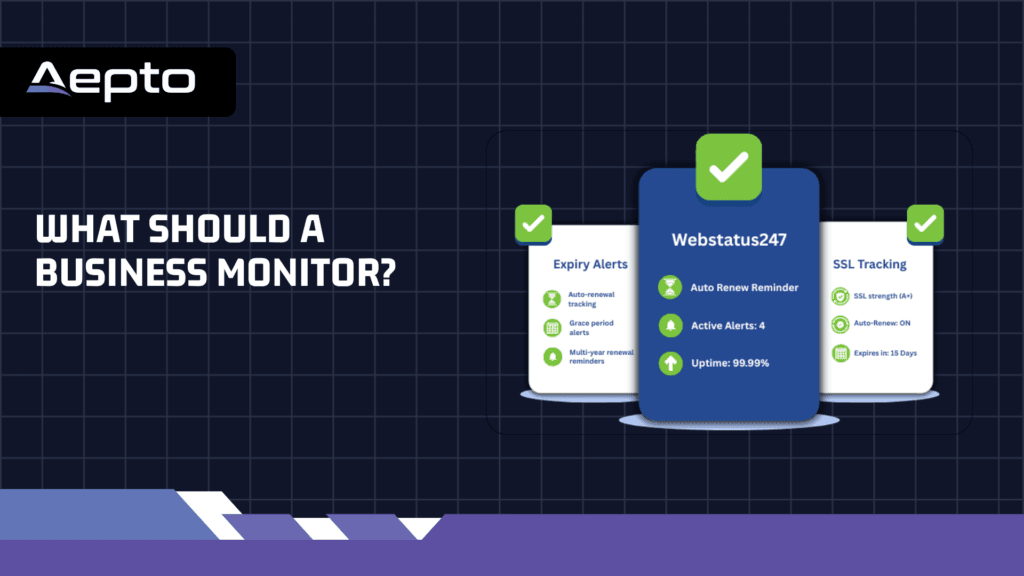
What Should a Business Monitor?
A practical business monitoring strategy can be divided into several categories:
| Monitoring Area | What to Monitor | Why It Matters |
|---|---|---|
| Domain | Expiration and registration | Prevent domain loss |
| Ownership | Registrant and transfer changes | Detect unauthorized activity |
| DNS | A, MX, TXT, CNAME, NS records | Prevent configuration problems |
| SSL | Certificates and expiration | Maintain secure HTTPS |
| Uptime | Website availability | Reduce downtime |
| Content | Important page changes | Detect unauthorized modifications |
| Nameservers | Authoritative DNS changes | Detect suspicious configuration changes |
| Domain Lock | Lock/unlock status | Reduce transfer risks |
| Brand | Lookalike domains | Detect impersonation |
| SPF, DKIM, DMARC, MX | Protect email reliability | |
| Portfolio | All company domains | Centralize visibility |
| Expenses | Registration and renewal costs | Control domain spending |
| Security | Vulnerabilities and threats | Reduce security risk |
How AI Can Improve Domain Monitoring
Traditional monitoring often relies on predefined rules.
For example: “Send an alert 30 days before this domain expires.”
That’s useful, but modern businesses need more context. AI-powered monitoring can potentially analyze large amounts of domain, DNS, website, and security information and help identify patterns that deserve attention. Instead of monitoring one event at a time, AI can help businesses understand relationships between different signals.
For example: Unexpected nameserver change + DNS modification + website content change = potentially suspicious activity.
That type of contextual monitoring can be particularly valuable for businesses managing large domain portfolios. Aepto’s approach to domain intelligence combines monitoring, alerts, discovery, security, and management features to give businesses greater visibility into their digital assets. Businesses interested in the broader concept can read The Role of AI in Domain Monitoring.
What Is the Best Way to Monitor All These Assets?
For a small business with one or two domains, manual monitoring may seem manageable.
As the business grows, however, the number of assets increases.
A company may eventually have:
- Multiple domains
- Multiple registrars
- Multiple websites
- Multiple SSL certificates
- Multiple DNS providers
- Regional websites
- Product domains
- Marketing domains
Checking each one manually creates unnecessary administrative work and increases the chance that an important warning will be missed.
An automated platform can centralize monitoring and send alerts when something changes.
Useful capabilities include:
- Automated domain expiration alerts
- Ownership change monitoring
- DNS monitoring
- SSL monitoring
- Website uptime monitoring
- Content monitoring
- Domain discovery
- Security alerts
- Webhooks
- Centralized domain management
- Portfolio visibility
Businesses can also use Alert Webhooks Integration to connect monitoring alerts with their existing workflows and systems.
A Better Approach to Business Domain Monitoring
The biggest mistake businesses can make is treating domain monitoring as nothing more than an expiration reminder. Expiration matters, but it is only one event in the lifecycle of a digital asset. A stronger monitoring strategy looks at the entire environment surrounding the domain:
Domain → DNS → SSL → Website → Email → Ownership → Security → Brand → Availability
Monitoring these areas gives businesses a much more complete view of their online presence. It also changes domain management from a reactive process into a proactive one. Instead of discovering a problem after customers report it, businesses can receive an alert when something changes and investigate it immediately.
Final Thoughts on What Should Businesses Monitor Besides Domain Expiration
So, what should businesses monitor besides domain expiration?
At a minimum, businesses should monitor domain ownership, DNS records, SSL certificates, website uptime, content changes, nameservers, domain lock status, email security records, lookalike domains, vulnerabilities, and their overall domain portfolio.
The more important the online presence is to a business, the more comprehensive its monitoring strategy should be.
Domain expiration is only one potential failure point. A secure and reliable digital presence requires continuous visibility across the entire domain ecosystem.
With automated and AI-powered monitoring, businesses can spend less time manually checking domains and more time responding to the issues that actually matter.
For organizations looking to build a more intelligent approach to domain management, Aepto provides tools for domain monitoring, discovery, protection, uptime monitoring, alerts, and centralized domain management.
Read more of our blogs:
- How Businesses Can Save Money on Domain Monitoring: A Practical Guide
- How to Use Discounts for Monitoring Multiple Websites
- What Should Businesses Monitor Besides Domain Expiration?
- Why Do Businesses Need Domain Monitoring? A Complete Guide
- AI for Network Security and Monitoring: The Comprehensive Guide