Monitoring one website is relatively simple. Monitoring 10, 20, or even hundreds of websites is a completely different challenge.
As a website portfolio grows, so does the need for reliable uptime monitoring, domain monitoring, SSL checks, DNS monitoring, and security alerts. Paying for monitoring services individually can quickly increase operational costs, especially for web agencies, businesses with multiple brands, and organizations managing large domain portfolios.
This is where website monitoring discounts can make a meaningful difference.
A well-structured monitoring plan can help you protect multiple websites without allowing monitoring costs to grow unnecessarily. However, the key is to understand what you are paying for, how monitoring limits work, which websites need continuous monitoring, and how to use promotional pricing without compromising visibility.
In this guide, we will explain how to use discounts for monitoring multiple websites, how to calculate your potential savings, what to look for in a monitoring plan, and how to build a cost-effective monitoring strategy for a growing website portfolio.
Why Monitor Multiple Websites?
Businesses rarely operate just one digital property.
A company might manage:
- Its main corporate website
- Regional websites
- Product websites
- Landing pages
- Customer portals
- E-commerce stores
- Campaign websites
- Blogs
- Documentation websites
- Staging environments
Web agencies may manage even more.
Without centralized monitoring, teams often rely on manual checks or discover problems after customers report them.
A website can become unavailable because of:
- Hosting failures
- DNS problems
- Expired domains
- SSL certificate issues
- Server configuration errors
- Application crashes
- Database failures
- Unexpected content changes
- Network connectivity problems
Monitoring provides an early warning system.
Instead of waiting for someone to notice that a website is unavailable, an automated monitoring system can detect the problem and notify the responsible team.
For businesses managing multiple domains, domain monitoring is particularly important because domain-related problems can take an otherwise healthy website offline.
What Does Multi-Website Monitoring Usually Include?
Before looking for discounts, understand what you actually need to monitor.
A comprehensive multi-website monitoring strategy can include several different monitoring categories.
Uptime Monitoring
Uptime monitoring checks whether a website is reachable and responding correctly.
Depending on the monitoring system, checks may evaluate:
- HTTP status codes
- Response times
- HTTPS availability
- Connection failures
- Regional availability
For example:
Monitoring System
       |
       +---- Website A → HTTP 200 → Healthy
       |
       +---- Website B → HTTP 200 → Healthy
       |
       +---- Website C → Timeout → Alert
       |
       +---- Website D → SSL Error → Alert
This is especially useful when you manage websites hosted across different servers or providers.
Limitless Hosting’s 10th Anniversary Disocounts!
decade of reliable hosting and unbeatable value. Celebrate with our biggest deals yet in Aepto as well.
Domain Monitoring
A domain can cause problems even when the hosting server remains online.
Monitoring can help identify important domain events such as:
- Expiration
- Ownership changes
- DNS changes
- Nameserver changes
- Registrar changes
- Configuration changes
For organizations with many domains, centralized monitoring becomes increasingly valuable.
SSL Monitoring
SSL certificates require regular attention.
An expired certificate can result in browser warnings, broken HTTPS connections, and loss of customer trust.
Monitoring can track certificate expiration and provide advance notifications so teams have time to renew certificates.
Aepto’s guide on how to continuously monitor SSL certificates explains why certificate monitoring should be treated as an ongoing operational process rather than a one-time configuration.
DNS Monitoring
DNS changes can affect website availability, email delivery, and application connectivity.
For larger portfolios, monitoring DNS records can help identify unexpected changes before they cause significant disruption.
Website Content Monitoring
Availability is not the only thing that matters.
A website can return HTTP 200 while its content has been modified unexpectedly.
For example:
Website Status: ONLINE
HTTP Status: 200
Content: Changed unexpectedly
Security Risk: Potential
This is why organizations with important websites may also benefit from content monitoring and change detection.
1. Count the Websites You Actually Need to Monitor
The first step in using a monitoring discount effectively is calculating your actual monitoring requirements.
Do not simply count every domain you own.
Create categories such as:
| Website | Importance | Uptime Monitoring | Domain Monitoring | SSL Monitoring |
|---|---|---|---|---|
| Main Business Site | Critical | Yes | Yes | Yes |
| Company Blog | Medium | Yes | Yes | Yes |
| Campaign Site | Medium | Yes | Yes | Yes |
| Development Site | Low | Optional | Yes | Optional |
| Client Website | Critical | Yes | Yes | Yes |
This immediately gives you a clearer picture of your requirements.
You may discover that not every website needs exactly the same monitoring configuration.
Critical production websites should generally receive the highest level of monitoring, while temporary development websites may require fewer checks.
2. Look for Monitoring Plans That Support Multiple Websites
When comparing monitoring discounts, look beyond the headline price.
The important question is:
How many websites, domains, or monitoring checks does the plan actually support?
A plan advertised as inexpensive may become expensive if every additional website requires another subscription.
For example, imagine you need to monitor 25 websites.
If your monitoring provider charges separately for every website, your costs could increase linearly:
5 websites   → Lower cost
10 websites  → Higher cost
25 websites  → Much higher cost
50 websites  → Significantly higher cost
A monitoring platform with portfolio-oriented pricing may provide better value as your website count increases.
When evaluating a discount, check:
- Number of websites supported
- Number of monitoring checks
- Monitoring frequency
- Alert limits
- Domain monitoring limits
- SSL monitoring limits
- Team members
- API access
- Webhooks
- Historical data
- Data retention
- Regional monitoring
- Additional website pricing
3. Calculate the Real Value of the Discount
Never evaluate a monitoring discount based only on its percentage.
Instead, calculate the total cost for your entire portfolio.
Suppose a monitoring service normally costs $10 per month and offers a 40% promotional discount.
The discounted price would be:
$10 × 60% = $6 per month
For one year:
$6 × 12 = $72
Your annual saving would be:
$120 − $72 = $48
Now consider a portfolio of 20 websites.
If the pricing structure allows those websites to be monitored under the same plan, the savings can become substantially more valuable.
The exact calculation depends on the monitoring provider’s pricing model, but the principle remains the same:
Calculate the discount against the total number of websites you need to monitor.
4. Take Advantage of Annual Monitoring Discounts
If you know that you will monitor the same websites throughout the year, an annual promotional plan may provide better value than paying monthly.
This can be particularly useful for:
- Established businesses
- Web agencies
- SaaS companies
- E-commerce businesses
- Domain investors
- Large website portfolios
However, annual billing should be evaluated carefully.
Before committing, check:
- Promotional price
- Normal renewal price
- Number of websites included
- Additional website costs
- Cancellation terms
- Monitoring limits
- Feature restrictions
- Future upgrade costs
The objective is to reduce the long-term cost of monitoring without locking yourself into a plan that no longer fits your requirements.
5. Prioritize Your Most Important Websites
You do not necessarily need to treat every website identically.
Create monitoring tiers.
Tier 1: Critical Websites
These could include:
- E-commerce stores
- SaaS applications
- Corporate websites
- Revenue-generating websites
- Customer portals
Monitor these continuously and configure immediate alerts.
Tier 2: Important Websites
Examples include:
- Blogs
- Marketing websites
- Product websites
- Regional websites
These should still have reliable uptime and domain monitoring.
Tier 3: Low-Priority Websites
These might include:
- Development websites
- Temporary landing pages
- Experimental projects
- Archived websites
The monitoring requirements may be lower.
This approach helps you use your monitoring budget more efficiently.
Instead of spending the same amount on every website, allocate monitoring resources according to business impact.
6. Use Discounts Before Expanding Your Monitoring Portfolio
Website portfolios often grow gradually.
You might start with five websites and eventually manage 30.
When you receive a monitoring promotion, consider whether it can accommodate your expected growth.
For example:
Current portfolio: 10 websites

Expected growth:
+5 websites this year
+10 websites next year

Potential requirement:
25 websites
If a discounted plan supports your expected portfolio size, taking advantage of the promotion may be more efficient than repeatedly upgrading later.
However, do not purchase substantially more capacity than you reasonably expect to use.
The goal is to find the right balance between:
Current requirements + realistic growth + reasonable capacity
7. Combine Uptime and Domain Monitoring
One of the most effective ways to protect multiple websites is to monitor both the website and the domain.
These are different failure points.
Consider this scenario:
Domain
   ↓
DNS
   ↓
Hosting Server
   ↓
Web Server
   ↓
Application
   ↓
Website
A problem at any point can affect availability.
For example, the hosting server might be completely operational while the domain has expired.
Conversely, the domain may be valid while the website itself is returning a 500 error.
This is why monitoring should cover multiple layers rather than relying solely on an uptime check.
Aepto’s domain watch capabilities can be particularly relevant when managing a large collection of domains that require ongoing visibility.
8. Monitor SSL Certificates Across the Entire Portfolio
SSL management becomes increasingly difficult as the number of websites increases.
Imagine managing 50 websites manually.
Each site may have:
- A different certificate
- A different expiration date
- A different hosting environment
- A different renewal process
A spreadsheet can help, but it still requires manual maintenance.
Automated SSL monitoring can detect certificates approaching expiration and alert the appropriate team.
This prevents a common problem:
The website is online, but HTTPS is no longer trusted.
When evaluating monitoring discounts, determine whether SSL monitoring is included or charged separately.
A discount that includes several monitoring capabilities can sometimes provide considerably more value than a cheaper plan that only checks uptime.
9. Centralize Monitoring Instead of Using Multiple Tools
Managing multiple websites with different monitoring services can create unnecessary complexity.
For example:
Website Group A → Monitoring Tool 1
Website Group B → Monitoring Tool 2
Domains → Spreadsheet
SSL → Calendar
DNS → Manual checks
This approach makes it difficult to understand the overall state of your infrastructure.
A centralized monitoring platform can provide a more consistent workflow.
Instead of checking several dashboards, your team can have a single operational view of websites, domains, and alerts.
Aepto’s domain portfolio management approach is useful for organizations that need to maintain visibility across a large collection of digital assets.
10. Use Alerts to Reduce Manual Monitoring
The purpose of monitoring is not to make someone stare at a dashboard all day.
Automated alerts should notify the appropriate people when something requires attention.
Depending on your setup, alerts may be delivered through:
- Webhooks
- Messaging systems
- Incident-management platforms
- Other integrations
For larger website portfolios, webhook-based workflows can help connect monitoring events with existing operational systems.
For example:
Website Failure
      ↓
Monitoring Alert
      ↓
Webhook
      ↓
Incident System
      ↓
Engineering Team
      ↓
Investigation
This becomes increasingly valuable when one team is responsible for dozens or hundreds of websites.
11. Look for Discounts That Include the Features You Need
The cheapest monitoring subscription is not always the best deal.
When evaluating a promotion, compare the total feature set.
| Feature | Basic Monitoring | Portfolio Monitoring |
|---|---|---|
| Uptime checks | ✓ | ✓ |
| Domain monitoring | Limited/Optional | ✓ |
| SSL monitoring | Limited/Optional | ✓ |
| DNS monitoring | Limited/Optional | ✓ |
| Multiple websites | Limited | ✓ |
| Automated alerts | ✓ | ✓ |
| Webhooks | May be limited | ✓ |
| Portfolio management | Limited | ✓ |
A slightly more expensive discounted plan can provide significantly better value if it eliminates the need for multiple separate tools.
12. Avoid Paying for Unused Monitoring Capacity
Discounts can sometimes encourage unnecessary purchases.
Suppose you currently manage 12 websites but purchase a plan designed for 100 because the promotional price looks attractive.
If you have no realistic expectation of reaching 100 websites, the discount may not actually save money.
Calculate:
Cost per monitored website
For example:
Annual plan: $120
Websites monitored: 20

$120 ÷ 20 = $6 per website/year
Then compare that figure against alternative plans.
This gives you a more useful measurement than the advertised discount percentage.
13. Use Monitoring Discounts for Client Websites
Web agencies can benefit significantly from multi-website monitoring discounts.
Instead of purchasing separate monitoring subscriptions for every client, an agency can look for a plan designed to support a larger website portfolio.
This can simplify:
- Client reporting
- Uptime tracking
- Incident detection
- Domain management
- SSL monitoring
- Website maintenance
It can also make monitoring easier to include as part of a website maintenance package.
For example:
Website maintenance package
- Hosting
- Security updates
- Backups
- Uptime monitoring
- SSL monitoring
- Domain monitoring
- Performance monitoring
The agency can then spread the cost of monitoring across multiple clients rather than treating it as an isolated expense for every project.
14. Review Monitoring Costs as Your Website Portfolio Changes
Your monitoring requirements will change over time.
Websites may:
- Launch
- Shut down
- Move to another provider
- Become more important
- Receive more traffic
- Become revenue-generating
- Move from development to production
Review your monitoring portfolio periodically.
A simple quarterly review can identify:
- Unused monitoring slots
- Websites that need stronger monitoring
- Expired projects
- Duplicate monitoring checks
- Unnecessary subscriptions
- New websites that need monitoring
This keeps your monitoring budget efficient.
15. Combine Monitoring Discounts With Infrastructure Savings
Monitoring is only one component of website operating costs. You may also spend money on:
- Hosting
- Domains
- SSL
- Backups
- Security
- CDN services
- Software
When planning your website infrastructure budget, look for legitimate promotions across the services you actually need.
For example, if you are also reviewing hosting expenses, you can check current hosting specials from Limitless Hosting when planning infrastructure costs for websites in your portfolio. The important principle is to avoid purchasing services simply because they are discounted. A discount is valuable only when the underlying service is useful.
A Practical Strategy on how to use Discounts for Monitoring Multiple Websites
If you manage multiple websites, use the following process.
Step 1: Create a website inventory
List every website and domain that requires monitoring.
Step 2: Assign a business priority
Classify each website as critical, important, or low priority.
Step 3: Identify monitoring requirements
Determine which sites need uptime, domain, SSL, DNS, and content monitoring.
Step 4: Calculate your current costs
Add the cost of all existing monitoring services.
Step 5: Compare portfolio pricing
Look for monitoring plans that support multiple websites under a single account.
Step 6: Calculate the real discount
Compare the promotional price with the normal annual cost.
Step 7: Check renewal pricing
Do not stop at the introductory price.
Step 8: Estimate future growth
Consider how many websites you expect to add.
Step 9: Configure automated alerts
Make sure important failures generate notifications automatically.
Step 10: Review the portfolio regularly
Remove monitoring from retired websites and prioritize new critical assets.
Common Mistakes When Using Monitoring Discounts
Choosing a plan based only on the discount
A 70% discount sounds impressive, but it means little if the plan cannot monitor the number of websites you need.
Ignoring renewal prices
Always determine what you will pay after the promotional period.
Monitoring only uptime
A website can be online while its domain, SSL certificate, DNS, or content has a problem.
Treating every website equally
Critical revenue-generating websites may require more monitoring attention than temporary projects.
Buying excessive capacity
Do not pay for hundreds of monitoring slots if you only manage a few websites and have no realistic growth plan.
Using too many separate monitoring tools
Multiple dashboards can make operations harder instead of easier. Centralization can simplify monitoring for larger portfolios.
How Aepto Helps With Multi-Website Monitoring
As your website portfolio grows, manually checking every domain and website becomes increasingly difficult.
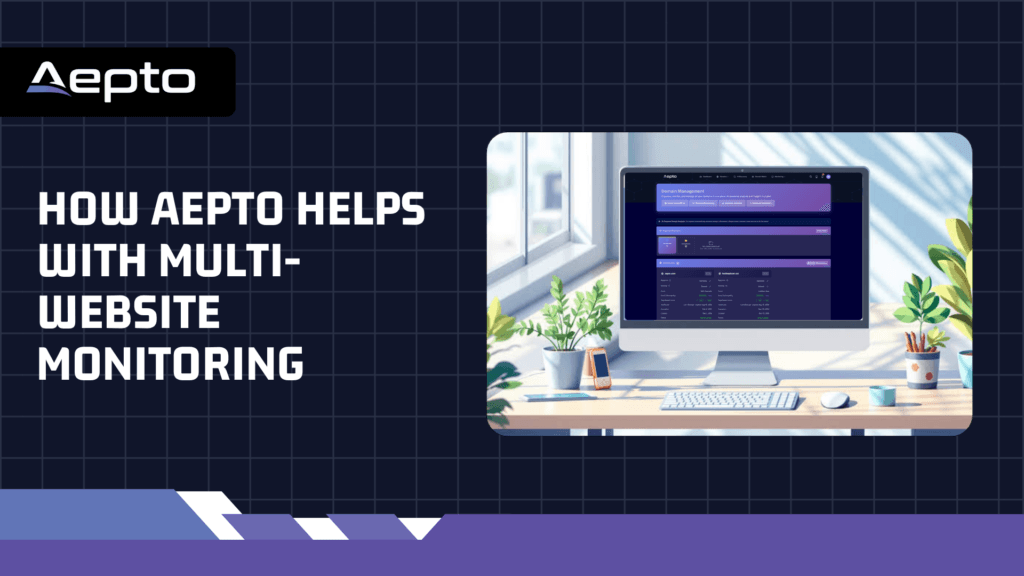
Aepto is designed to provide centralized visibility across important digital assets, helping businesses monitor domains, websites, SSL certificates, and other infrastructure components.
The goal is not simply to monitor more websites. It is to make monitoring more manageable, automated, and actionable as your portfolio grows.
By combining the right monitoring coverage with a suitable promotional plan, you can reduce monitoring costs without reducing visibility. The best discount is therefore not necessarily the one with the largest percentage.
It is the one that provides the monitoring capacity and features your portfolio actually needs at the lowest sustainable cost.
Conclusion
Using discounts for monitoring multiple websites can significantly reduce the cost of managing a growing website portfolio, but the strategy requires more than finding a promotional code.
Start by identifying which websites need monitoring, determine the types of checks required, compare multi-site monitoring plans, calculate the real annual savings, and always consider renewal pricing.
Most importantly, do not allow cost optimization to reduce your visibility.
A reliable multi-website monitoring strategy should cover the areas that can cause real business disruption, including uptime, domains, SSL certificates, DNS, and important website changes.
As your portfolio grows, centralized monitoring becomes increasingly valuable. Instead of manually checking dozens of websites, automated monitoring can continuously watch your digital assets and alert your team when something requires attention.
With the right monitoring platform and a carefully selected discount, you can protect more websites while keeping your operational costs under control.
Frequently Asked Questions
1. Can I use one monitoring plan for multiple websites?
Yes, many monitoring platforms offer plans designed to monitor multiple websites, domains, or monitoring checks under a single account. Always check the provider’s specific limits before purchasing.
2. Are website monitoring discounts worth it?
They can be, particularly for businesses, agencies, and developers managing multiple websites. The most important factor is the total cost of monitoring your entire portfolio rather than the advertised discount percentage.
3. What should I monitor across multiple websites?
At minimum, consider uptime, domain expiration, SSL certificates, and DNS. Critical websites may also benefit from content monitoring, performance checks, and additional security monitoring.
4. Should every website have the same monitoring level?
Not necessarily. Critical production and revenue-generating websites should generally receive more comprehensive monitoring than temporary development or low-priority websites.
5. Should I pay for annual monitoring to get a discount?
Annual billing can provide better value when you know you will need monitoring throughout the year. However, compare the promotional price, renewal cost, cancellation terms, and included monitoring capacity before committing.
6. How can agencies reduce the cost of monitoring client websites?
Agencies can look for monitoring plans that support multiple websites under one account. This can simplify management and potentially reduce the cost compared with purchasing separate monitoring subscriptions for every client.
7. Is uptime monitoring enough for a website portfolio?
No. Uptime monitoring only addresses one part of website availability. Domains, DNS, SSL certificates, content, and application-level problems can also cause significant issues, so a broader monitoring strategy is recommended for important websites.
Read more of our blog:
- How Businesses Can Save Money on Domain Monitoring: A Practical Guide
- How to Use Discounts for Monitoring Multiple Websites
- What Should Businesses Monitor Besides Domain Expiration?
- Why Do Businesses Need Domain Monitoring? A Complete Guide
- AI for Network Security and Monitoring: The Comprehensive Guide