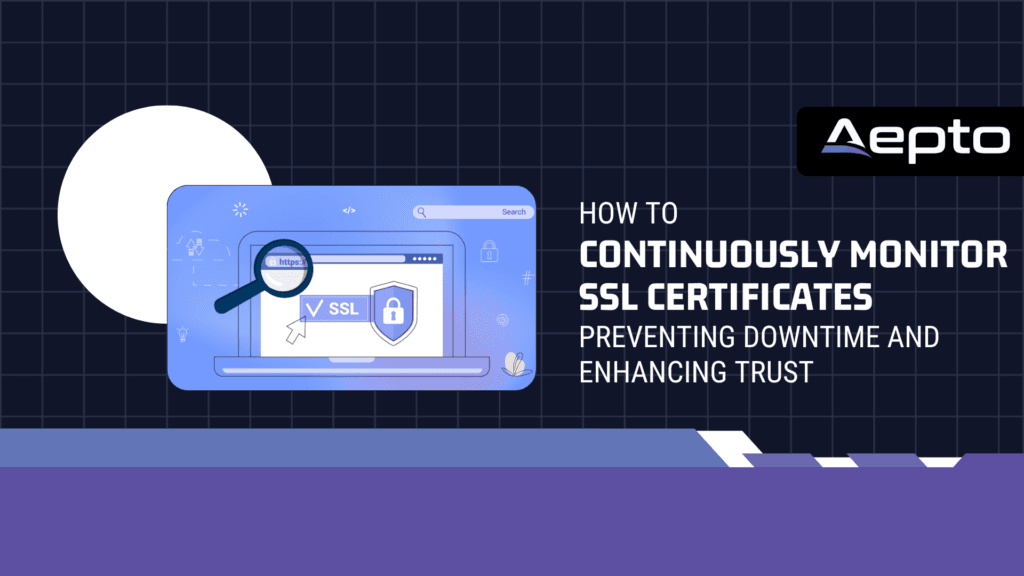
Why Is SSL Certificate Important and Why Should You Continuously Monitor SSL Certificates
In the modern digital landscape, an SSL/TLS certificate is more than just a cryptographic protocol; it is the cornerstone of digital trust. It is the green padlock that reassures a customer, the encryption layer that protects a transaction, and a critical signal that search engines use to determine the legitimacy of a website.
However, many organizations treat SSL management as a “set and forget” task. This complacency leads to one of the most common—and preventable—causes of catastrophic downtime: Certificate Expiration.
When an SSL certificate expires, the consequences are immediate. Browsers display a “Your connection is not private” warning, traffic plummets, and brand reputation is damaged in seconds. To avoid this, businesses must shift from manual tracking to Continuous SSL/TLS Monitoring.
Today, We will explore the technical mechanics of SSL monitoring, the risks of mismanagement, and how to build a resilient monitoring strategy using Aepto’s AI-powered smart domain insights.
The Anatomy of an SSL Crisis
Before diving into monitoring solutions, it is essential to understand why SSL management has become so complex in recent years.
The Shift to Shorter Lifespans
Historically, SSL certificates could be issued for up to five years. Over time, the CA/Browser Forum (the governing body of the industry) has aggressively shortened these lifespans to improve security. Today, the maximum validity for a public SSL certificate is 398 days (roughly 13 months). There is even ongoing discussion about moving toward 90-day certificates to align with automated standards like Let’s Encrypt.
Shorter lifespans mean more frequent renewals, which exponentially increases the “surface area” for human error.
The Multi-Cloud and Subdomain Explosion
Modern enterprises do not just have one website. They have hundreds of subdomains, staging environments, API endpoints, and microservices scattered across various cloud providers. Tracking a certificate on api.example.com while simultaneously managing one for marketing-campaign.io is a logistical nightmare without a centralized system. This is a primary reason why centralized domain management matters more than ever.
Ready to scale your workflow?
Explore how our latest tools can save you hours of manual work every week.
Why Continuous Monitoring is Mandatory
Manual spreadsheets are the enemy of uptime. Continuous monitoring provides a safety net that manual checks cannot replicate.
Real-Time Expiration Tracking
The most basic function of monitoring is tracking the expiration date. A continuous system checks the certificate daily (or hourly) and triggers a cascade of smart domain renewal alerts well before the deadline.
Detecting “Shadow” Certificates
Sometimes, a developer might issue a free SSL certificate for a testing environment without informing the IT department. If that testing environment is later pushed to production, the “shadow” certificate becomes a liability. Continuous monitoring scans your entire IP range and subdomain list to “discover” these hidden certificates.
Monitoring Chain of Trust and Intermediate Certs
An SSL certificate is only as strong as its chain. If an intermediate certificate is revoked or incorrectly configured, the entire connection fails, even if the primary certificate is valid. Monitoring tools simulate a full browser handshake to ensure the entire chain is healthy.
The Technical Pillars of SSL Monitoring
A robust monitoring strategy rests on four technical pillars:
Automated Scanning and Discovery
The monitoring engine must be proactive. It shouldn’t just wait for you to input a domain; it should use AI-powered smart domain insights to identify all domains associated with your organization and check their SSL status automatically.
Protocol and Cipher Suite Analysis
Security isn’t binary. A certificate might be “valid” but using an outdated protocol like TLS 1.0 or 1.1, which are vulnerable to exploits. Continuous monitoring audits your server’s configuration to ensure you are using modern, secure protocols (TLS 1.2 or 1.3).
CRL and OCSP Checking
If a certificate is compromised, it is added to a Certificate Revocation List (CRL) or checked via the Online Certificate Status Protocol (OCSP). Monitoring tools check these lists in real-time. If your certificate is revoked by the CA for any reason, you need to know before your users do.
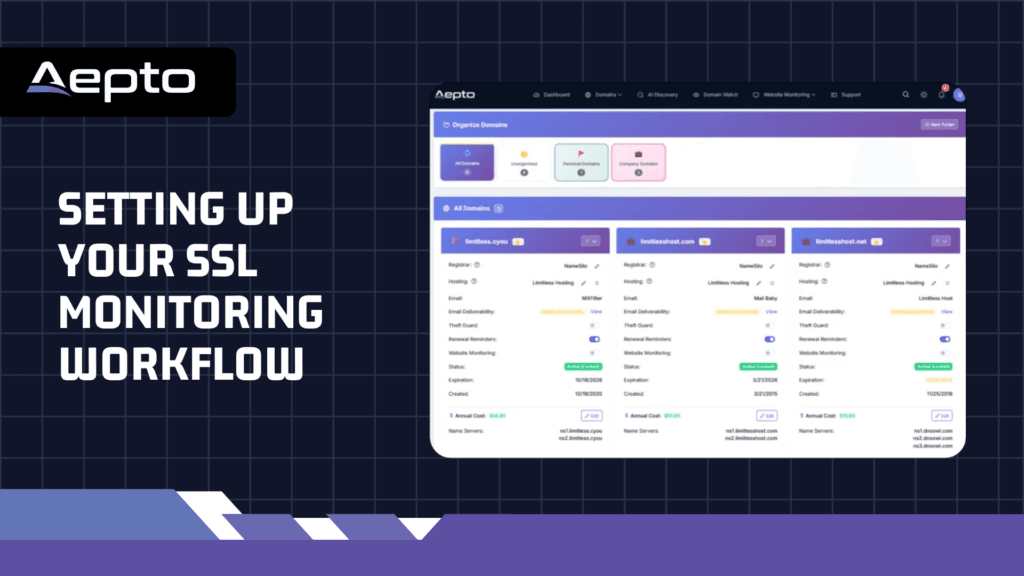
Setting Up Your SSL Monitoring Workflow
At Aepto, we recommend a tiered approach to monitoring that integrates with your broader one-click domain management workflow.
Step 1: Inventory Consolidation
You cannot monitor what you don’t know you own. Begin by importing all your domains into a centralized dashboard. If you are using a high-performance host like Limitless Hosting, ensure their provided SSL details are synced with your monitoring tool.
Step 2: Establish the Alert Hierarchy
Not all alerts are created equal. Set up a multi-stage notification system:
- 60 Days Out: A low-priority ticket is created.
- 30 Days Out: An email is sent to the IT manager.
- 14 Days Out: An urgent notification is sent via Slack or SMS.
- 7 Days Out: A critical alert is triggered, escalating to the CTO.
Step 3: Implement Global Uptime Checks
SSL issues can sometimes be regional. A configuration might work in New York but fail in Singapore due to CDN caching issues. Using smart global uptime monitoring ensures your SSL is valid and reachable from every corner of the globe.
Step 4: Verification of Installation
After renewal, the monitoring tool must verify that the new certificate was installed correctly. A common mistake is renewing the certificate with the CA but forgetting to update the files on the web server. Continuous monitoring will catch this discrepancy immediately.
Avoiding Common SSL Mistakes
Our research into the 7 common domain mistakes that cost businesses traffic and revenue shows that SSL errors are among the most expensive. Here is how to avoid them:
Ignoring Multi-Domain (SAN) Complexity
If you use a Subject Alternative Name (SAN) certificate to cover multiple domains, remember that renewing it for one domain affects all of them. Monitoring must track every single name listed on the SAN to ensure no service is left behind.
Forgetting the “Mixed Content” Problem
Even with a valid SSL, your site might show “Not Secure” if you are loading images or scripts via http:// instead of https://. Sophisticated monitoring tools, like those discussed in our guide on ai-driven-website-content-monitoring, scan your source code for these “Mixed Content” warnings.
Neglecting Domain Ownership
SSL certificates require “Domain Validation.” If your domain registration expires, you cannot renew your SSL. This is why how does ai domain monitoring work is so critical—it protects the foundation (the domain) so the security layer (the SSL) can function.
The Future of SSL: AI and Automation
As we move toward a more automated web, the role of AI in SSL monitoring is expanding:
- Predictive Remediation: AI can predict which certificates are likely to fail renewal based on past API performance of specific Certificate Authorities.
- Auto-Installation: Integration between monitoring tools and hosting platforms allows for “Auto-Fix” capabilities, where a detected expiry triggers an automatic renewal and installation.
- Advanced Threat Detection: Monitoring will soon include “Certificate Transparency” log analysis to detect if someone else has maliciously issued a certificate for your domain (a common tactic in phishing).
Frequently Asked Questions (FAQs)
What happens if my SSL certificate expires?
Immediately upon expiration, browsers will block access to your site with a “Connection is not private” warning. This breaks user trust, halts transactions, and negatively impacts your SEO rankings.
Does a valid SSL certificate mean my server is secure?
Not necessarily. A certificate can be valid, but your server might still allow weak encryption protocols (like SSL 3.0) or vulnerable cipher suites. Continuous monitoring checks both the certificate status and the server’s TLS configuration.
How often should I monitor my SSL status?
Monitoring should be continuous. Checking once a week isn’t enough to catch sudden revocations or configuration errors. High-performance tools monitor SSL health every few hours or even minutes.
Can I monitor internal (Private) SSL certificates?
Yes, while most tools focus on public certificates, enterprise-grade monitoring can be configured to track internal certificates used for microservices or private intranets.
Is Let’s Encrypt better for monitoring?
Let’s Encrypt offers automated 90-day certificates. While automation reduces the manual burden, it actually makes monitoring more important, as you need to ensure the automation scripts haven’t failed.
Latest Posts:
- Is Domain Protection Worth It? The Definitive Guide to Safeguarding Your Digital Identity
- Corporate Domain Name Management and Renewals: The Enterprise Strategy Guide
- Multi-Domain Oversight: The Operator’s Playbook
- Free vs Paid Domain Monitoring: What Are the Differences?
- What Causes Website Downtime and How Can You Detect It Faster?