Overview: Domain Lock Status, What it means
In the modern digital economy, your domain name is not just a web address; it is the cornerstone of your brand’s identity, the hub of your communications, and a significant financial asset. Yet, behind the scenes of every URL, there is a complex system of security protocols known as “Domain Lock Statuses” or EPP codes.
This comprehensive guide explores the intricacies of domain status codes, the risks of unauthorized transfers, and how centralized management through Aepto provides the ultimate safeguard for your digital portfolio.
Introduction: The Silent Sentinels of the Web
Every time you type a URL into a browser, a series of invisible handshakes occurs. While most users focus on DNS and hosting, the most critical layer of security sits at the registry level. Domain “statuses” are the signals used by the global domain system to determine what can and cannot happen to a specific name.
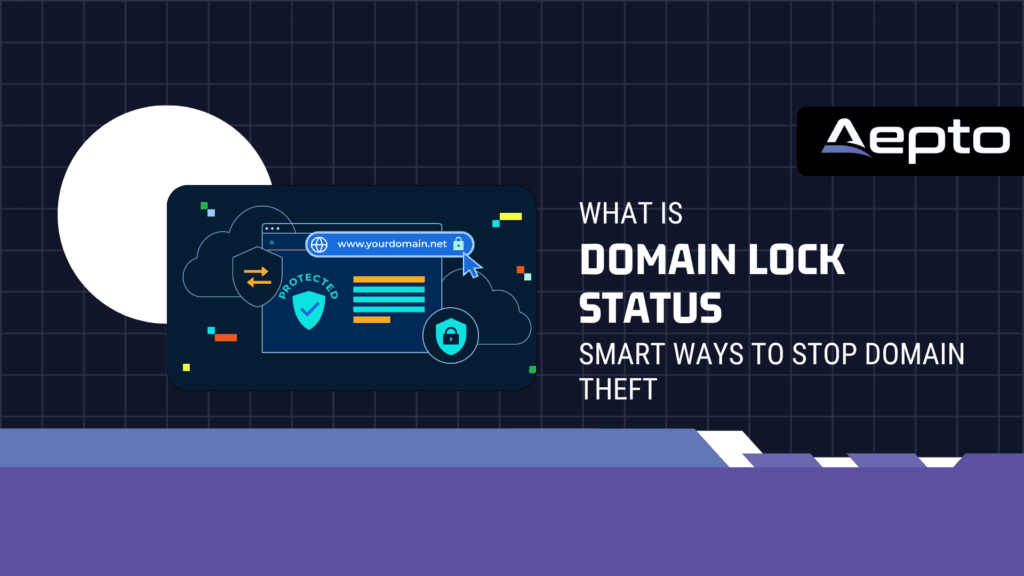
Historically, domain hijacking, the unauthorized transfer of a domain name, has cost businesses millions in lost revenue and brand equity. A domain lock is essentially a “digital seal” placed on your registration. When a lock is active, the domain cannot be moved to another registrar, modified, or deleted.
Despite its importance, the technical jargon surrounding ICANN (Internet Corporation for Assigned Names and Numbers) and EPP (Extensible Provisioning Protocol) can be overwhelming. Understanding these codes is no longer just a task for IT departments; it is a vital part of to simplify domain management for every proactive business owner.
Aepto: The Future of Domain Intelligence
Managing a single domain is straightforward. However, as businesses grow, they often accumulate dozens or hundreds of domains across various registrars (GoDaddy, Namecheap, Google, etc.). This fragmentation creates security blind spots.
Aepto was built to solve the chaos of decentralized domain ownership. It is an advanced, AI-driven platform designed to centralize, monitor, and protect your entire domain portfolio from a single intuitive dashboard.
By integrating AI-powered smart domain insights, Aepto goes beyond basic record-keeping. It proactively scans for status changes, identifies vulnerabilities, and ensures that your digital assets are always under your total control.
Ready to scale your workflow?
Explore how our latest tools can save you hours of manual work every week.
Deep Dive: Understanding EPP Status Codes
To master domain security, one must understand the Extensible Provisioning Protocol (EPP). These are the “Status Codes” you see when you perform a WHOIS lookup. They are divided into two main categories: Client Codes (set by your registrar) and Server Codes (set by the registry, like Verisign for .com).
ClientTransferProhibited (The Standard Lock)
This is the most common status and the one most people refer to as a “Registrar Lock.”
- What it does: Prevents the domain from being transferred to a different registrar.
- Why it matters: It acts as the primary defense against “Domain Slamming” and unauthorized hijacking.
- How it works: Even if a thief gains access to your email, they cannot initiate a transfer without first logging into your registrar account to “Unlock” the domain.
ClientUpdateProhibited
This status is a more restrictive secondary lock.
- What it does: Prevents the modification of contact details, DNS settings, and hostnames.
- Use Case: This is ideal for high-value domains that rarely change. It ensures that even if an account is compromised, the attacker cannot redirect your traffic by changing the Name Servers.
ServerTransferProhibited (Registry Lock)
This is the “Gold Standard” of security, often utilized by companies like Google, Amazon, or major financial institutions.
- Difference: While a Client lock can be toggled in a dashboard, a Server lock is implemented by the Registry itself (e.g., Verisign).
- The Process: To remove this lock, the registrar must contact the registry via a manual, out-of-band verification process (often involving phone calls or physical tokens). It is nearly impossible to bypass.
RedemptionPeriod and PendingDelete
These statuses occur after a domain expires.
- Redemption Period: A 30-day window where the original owner can still reclaim the domain, though usually at a higher fee.
- Pending Delete: The final stage before the domain is released back to the public. You cannot make changes during this phase.
Why You Need Constant Monitoring
A domain status is not a “set it and forget it” feature. There are several scenarios where a domain lock might be accidentally or maliciously removed:
- Human Error: An administrator might unlock a domain to perform a transfer and forget to re-lock it.
- Registrar Glitches: Rare but possible, technical updates at a registrar can sometimes reset status flags.
- Social Engineering: Hackers often call registrar support desks pretending to be the owner, requesting a “temporary unlock” for troubleshooting.
Without a tool like Aepto, you would only discover a status change during a manual audit or, worse, after your domain has already been moved. By utilizing domain protection and theft guard, Aepto acts as a 24/7 watchman, notifying you the instant a status changes from clientTransferProhibited to ok.
How Aepto Transforms Domain Management
Aepto isn’t just a monitoring tool; it’s an ecosystem designed for peace of mind. Here is how it helps specifically with domain lock status and overall security:
Centralized Status Visibility
If your company has domains spread across five different registrars, checking locks is a nightmare. Aepto aggregates all your data into one view. You can see at a glance which domains are “Locked” and which are “Open.” This is why centralized domain management matters more than ever.
Real-Time Status Alerts
Aepto’s engine constantly queries registry data. If a domain is unlocked, you receive an immediate alert via email. This allows you to respond in minutes rather than days. This is part of our broader AI domain monitoring strategy.
Bridging Security and Content
Domain status is only one part of the puzzle. An attacker might not steal the domain, but they might change the DNS to point to a clone of your site. Aepto’s Ai Driven Website & Content Monitoring works in tandem with status monitoring to ensure that what the user sees on the screen matches your intent.
Smart Renewal Integration
Many domain thefts occur during the expiration phase when security locks are naturally more fluid. Aepto integrates smart domain renewal alerts to ensure your domains never hit the “Redemption Period” or “Pending Delete” statuses, which are the most vulnerable times for an asset.
Case Study: The Cost of an Unlocked Domain
Imagine a mid-sized e-commerce company. During a routine migration, their IT team unlocks their primary .com domain. The migration is delayed, and the domain remains “Status: OK” (unlocked) for three weeks.
A malicious actor, using a leaked password from a previous data breach, logs into the registrar account. Because the domain is unlocked, they instantly request the EPP Authorization code and initiate a transfer to an offshore registrar. By the time the company realizes their email is down the next morning, the domain is already in a different country’s jurisdiction, making legal recovery nearly impossible.
With Aepto, the moment the status changed to “OK,” the CEO and the IT manager would have received a notification, allowing them to re-lock the domain before the EPP code could even be requested.
Strategic Recommendations for Portfolio Owners
To ensure your brand remains secure, we recommend the following protocol:
- Always Default to Locked: Every domain in your portfolio should carry the
clientTransferProhibitedstatus. - Audit Bi-Weekly: If you aren’t using an automated tool, manually check your WHOIS status for your top 10% of high-value domains every two weeks.
- Use Multi-Factor Authentication (MFA): Ensure your registrar account is protected by hardware keys or authenticator apps, not just SMS.
- Implement Registry Locks for Core Assets: For your primary brand domain, consider upgrading to a “Server” level lock if your registrar supports it, if you are looking for secure servers then this is where Limitless Hosting changes Theory to Practice in Cyber Security.
- Centralize Monitoring: Use Aepto to automate the heavy lifting, allowing your team to focus on growth rather than maintenance.
9. Conclusion: Securing Your Digital Legacy
In the digital age, your domain is your identity. Leaving your domain status to chance is equivalent to leaving your business’s legal deeds in a public park. The technical reality of EPP codes, clientTransferProhibited, clientUpdateProhibited, and serverTransferProhibited, are the boundaries of your digital safety.
By understanding these statuses, you take the first step toward true security. However, understanding is only half the battle. In an environment where threats move at the speed of light, manual checks are no longer sufficient.
Aepto provides the automated, AI-driven oversight needed to ensure your domains stay exactly where they belong. From one-click domain management to advanced status monitoring, we empower you to protect your assets with the sophistication they deserve.
Don’t wait for a notification of an unauthorized transfer. Take control of your domain lock status today with Aepto and secure your digital future.
For more information on optimizing your portfolio, check out our how does AI domain monitoring work guide or explore our domain folder management features to organize your assets effectively.
Frequently Asked Questions (FAQs)
What does “Domain Status: OK” mean?
Contrary to how it sounds, “OK” in a WHOIS record actually means the domain has no special restrictions. It is the default state of an unlocked domain. While the domain is functioning, it is also “transferable,” making it less secure than a domain with a “Prohibited” status.
How long does it take to lock or unlock a domain?
For most standard registrars, locking or unlocking is instantaneous through their management console. However, once you unlock a domain, it remains vulnerable until you manually re-lock it.
Can a domain be stolen if it is locked?
It is significantly harder. A locked domain cannot be moved unless the “lock” is removed first. A hacker would need access to your registrar account or your email to perform the unlock. This is why a combination of domain locks and MFA is essential.
Does a domain lock affect my website’s uptime?
No. Locking or unlocking a domain only affects the ability to transfer or modify the registration data. It has no impact on your DNS resolution, hosting, or website performance. To monitor performance, you should look into smart global uptime monitoring.
Why can’t I unlock my domain?
There are a few reasons a registrar might prevent you from unlocking:
- The domain was registered or transferred in the last 60 days (ICANN rule).
- The domain is currently involved in a legal dispute or UDRP proceeding.
- There is an outstanding balance or billing issue on your account.
Does Aepto work with all registrars?
Yes! Aepto is compatible with all domain registrars. Our system is designed to pull data regardless of where your domain is currently parked.
Read more of our guides:
- How Businesses Can Save Money on Domain Monitoring: A Practical Guide
- How to Use Discounts for Monitoring Multiple Websites
- What Should Businesses Monitor Besides Domain Expiration?
- Why Do Businesses Need Domain Monitoring? A Complete Guide
- AI for Network Security and Monitoring: The Comprehensive Guide