What Is Domain Name Portfolio Management? In the modern hyper-scale digital economy, corporate assets have moved far beyond the boundaries of physical factories, brick-and-mortar office spaces, and localized machinery. Today, a corporation’s most appreciating, strategic, and high-stakes infrastructure is entirely virtual. At the absolute foundation of this digital landscape sits your domain portfolio.
Every domain name in your inventory, from your primary customer-facing portal to defensive regional country-code Top-Level Domains (ccTLDs) and targeted product trademarks, is a premium piece of digital real estate. Together, these assets control your search engine positioning, route your global email networks, authenticate your secure cloud software, and establish your brand’s legal and intellectual authority.
Yet, despite this massive strategic importance, many organizations manage their domain portfolios with a dangerous level of neglect. As corporations execute regional expansions, launch localized marketing campaigns, and navigate mergers and acquisitions, their digital assets inevitably scatter across different departments, regional agencies, and fragmented registrar accounts.
This unmanaged accumulation of digital names, known as “domain sprawl,” creates massive financial waste, administrative drift, and highly exploitable security gaps.
To secure your brand’s legacy, your organization must transition from basic administrative spreadsheet tracking to active, automated domain portfolio management. This comprehensive guide will explore the strategic pillars of modern portfolio governance, the technical and financial risks of unmanaged digital assets, and how to build a resilient, automated framework that protects your digital real estate from the registrar registry to your backend hosting server.
Key Takeaways
Before exploring corporate domain governance frameworks, here is an executive summary of strategic portfolio management:
- Consolidation is the First Step: Fragmented domain portfolios are highly vulnerable. Reclaiming absolute visibility across all registrars is the baseline of enterprise security.
- Mitigate Administrative Drift: Unmanaged portfolios invite silent expirations, billing leaks, and unauthorized DNS drifts that disrupt core email and web services.
- Segment Assets by Value: Not all domains are equal. Group your portfolio into structured folders to target high-priority security resources without causing alert fatigue.
- Proactive Defense Against Squatters: Utilize AI discovery to brainstorm and register phonetic variations, typos, and homoglyphs before bad-faith actors can exploit them.
- Apply Hardened Security Controls: Enforce registry-level locks and strict access permissions to shield your high-value digital assets from hijacking attempts.
- Synchronize Domains with Secure Hosts: Secure domain routing must point to a hardened, enterprise-grade web hosting provider to build an ironclad, defense-in-depth perimeter.
1. Enterprise Nightmare: Understanding Domain Sprawl and Portfolio Fragmentation
Unlike small businesses that manage a single, static web address, modern corporations are constantly acquiring new digital assets. This portfolio expansion is a natural byproduct of business growth.
Consider how easily domain sprawl accumulates in a growing company:
- Defensive Registrations: Securing common typos, alternative extensions, and geographic country codes to protect primary trademarks from cybersquatters.
- Mergers and Acquisitions (M&A): Inheriting legacy domains, historical brand portals, and unverified DNS configurations from acquired corporations.
- Decentralized Marketing Campaigns: Registering temporary landing pages and microsites for localized product launches, regional events, or promotional joint ventures.
Without strict, centralized control, this rapid growth degenerates into administrative chaos. The marketing department registers promotional domains with one retail registrar using a corporate credit card; the legal team secures trademarks with another; and external web developers host secondary brands under personal registrar accounts.
This division of assets represents a massive operational liability. Over time, administrative credentials are lost, billing cards expire, and employees who originally registered the domains leave the organization. The business loses track of what it owns, where its assets are registered, and when they are scheduled to expire, paving the way for domain mistakes that cost businesses traffic and revenue.
Unchecked expansion across different registrars creates significant blind spots. To establish absolute control over your digital footprint, organizations must first understand centralized domain management in a hostile online landscape.
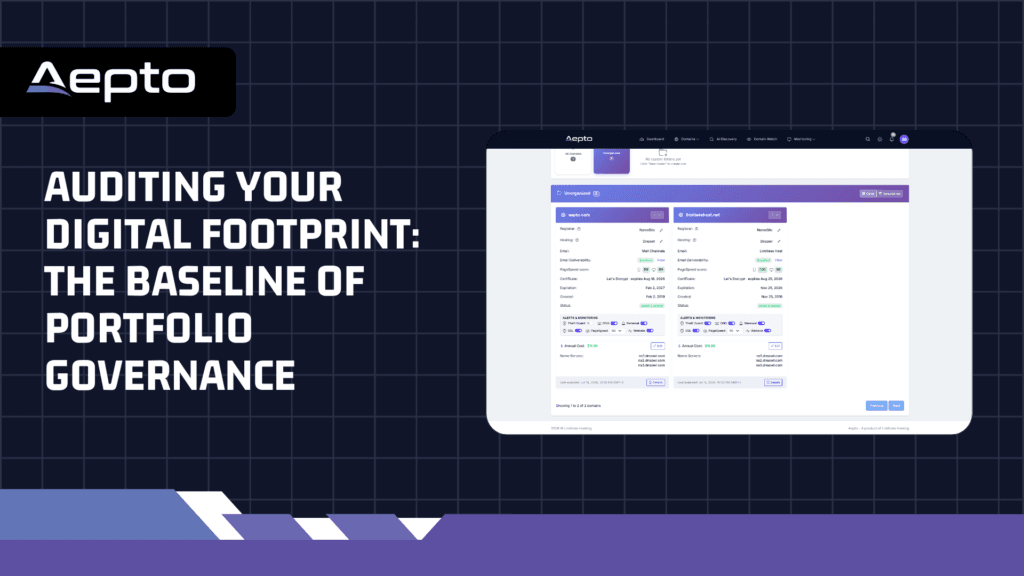
2. Auditing Your Digital Footprint: The Baseline of Portfolio Governance
You cannot protect what you do not know you own. The first step in professional portfolio management is executing a comprehensive digital asset discovery. This involves locating, auditing, and consolidating every single domain registered by your company across every registrar globally.
To establish an accurate inventory, your security and IT teams must answer several critical operational questions for every domain in your collection:
- What is the primary business purpose of this domain (e.g., active production, redirect, defensive block, or inactive campaign)?
- Which registrar physically holds the domain, and who is listed as the administrative, technical, and billing contact in the WHOIS registry?
- Is auto-renewal enabled, and is the linked payment method verified, active, and backed by redundant corporate credit cards?
- What are the authoritative nameservers, and are they pointing to verified, secure DNS servers?
As you begin to build this inventory, it is vital to clearly define the strategic role of every asset in your portfolio. To align your technical and legal teams on domain definitions, refer to our comprehensive guide on what is a business domain name.
THE DOMAIN INVENTORY AUDIT PIPELINE:
[ Discover Scattered Assets ] ➔ [ Map Registrars & Contacts ] ➔ [ Verify Billing & DNSSEC ] ➔ [ Classify Strategic Asset Tiers ]
3. Defensive Registrations and AI-Driven Discovery
A major challenge in domain portfolio management is determining which defensive variations are worth registering. While securing your core trademark is mandatory, no corporation can afford to buy every single alternative extension, keyword combination, or keyboard typo.
Historically, branding teams attempted to brainstorm these variations manually. They would write lists of common misspellings and check their availability one-by-one. This trial-and-error process is slow, inefficient, and guaranteed to miss advanced threat vectors like phonetic lookalikes or visual homoglyphs (where characters from non-Latin alphabets are used to mimic English letters).
To solve this challenge, modern enterprises leverage advanced ai domain discover platforms.
By analyzing your core trademarks, brand phonetics, and target industries, semantic AI engines generate hundreds of high-probability typosquatting, combosquatting, and homoglyph variations. It checks their global availability in real time, allowing your organization to defensively register high-risk variants before malicious actors can claim them.
4. Threat Intelligence and Active Portfolio Monitoring
While defensive registration builds an excellent preventative perimeter, you must supplement your assets with active, continuous threat detection. If a bad-faith actor registers a lookalike domain containing your trademark, you must detect it instantly to issue rapid takedown requests before they can host phishing sites or trick your customers.
Traditional security systems are built to defend files and networks inside your cloud environment, leaving them blind to external registry exploits. To bridge this operational gap, security operations centers must deploy active domain management security suites.
THE ACTIVE MONITORING PERIMETER:
[ Global Registry Scans ] ➔ [ Threat Score Evaluation ] ➔ [ Real-Time DNS Drift Alert ] ➔ [ Rapid Mitigation ]
By continuously scanning global registry zone files, DNS databases, and SSL certificate issuances, an active monitoring system flags any suspicious lookalike domain within hours of its creation. It tracks nameserver drifts, MX record configurations, and registrar changes on your owned domains, ensuring that any unauthorized modification to your external digital routing is detected and neutralized immediately.
5. Protecting High-Value Corporate Assets: Registry-Level Locks
For the primary domains that route your corporate email, validate your SSL certificates, and drive your core website traffic, standard registrar-level protections are not enough.
Standard retail registrars protect domains with basic “registrar locks” (such as clientTransferProhibited). While useful for blocking basic automated transfer requests, these software-level locks are easily bypassed if an attacker compromises your registrar account credentials through social engineering, credential stuffing, or session hijacking. Once inside, the attacker can simply toggle the lock off and transfer the domain away.
To protect your business-critical digital real estate, you must enforce the highest level of domain hardening. To understand how to apply and manage these advanced protections, review domain lock status.
A registry-level lock (represented by status codes like serverTransferProhibited and serverUpdateProhibited) is applied directly at the central registry level (such as Verisign for .com domains).
Unlike a registrar lock, a registry lock cannot be bypassed automatically. Any modification, DNS change, or transfer request requires manual, multi-factor verification between the registry engineers and authorized corporate officers. This manual validation process ensures that even if an attacker completely compromises your registrar account, your core domain remains secure, locked, and online.
6. Financial Optimization: Domain Expense and ROI Auditing
An enterprise domain portfolio is a significant, recurring financial line item. As organizations accumulate hundreds of defensive trademark registrations, geographical extensions, and temporary campaign domains over several years, their annual renewal fees can grow into a massive, unmanaged cost center.
To prevent financial leakage, modern enterprises must actively audit the business value of every domain in their inventory. By utilizing centralized dashboards, your finance and IT teams can perform regular, high-precision audits:
- Identify Orphaned Domains: Locate promotional microsites or campaign landing pages that were registered years ago but are no longer active, saving thousands of dollars in redundant renewals.
- Analyze Traffic Redirection Metrics: Match your renewal expenses against actual traffic redirect volumes, brand impressions, and search authority. If a defensive domain generates zero visits and holds no strategic trademark value, it can be safely pruned from the portfolio.
- Consolidated Billing Forecasts: Predict upcoming fiscal renewal surges across different registrars, allowing your purchasing departments to authorize payments smoothly and avoid accidental expirations due to payment processing declines.
7. Connecting Your Domain Portfolio to High-Performance Hosting
A domain name cannot fulfill its business purpose in a vacuum; it must ultimately resolve to an active, secure, and performant web server. While securing your domain’s renewal lifecycle and DNS integrity is critical, you must also ensure that the physical servers storing your website files, corporate databases, and API routes are secure and resilient.
A highly secure domain pointing to a slow, unpatched, or unmanaged host remains an easy target for attackers looking to disrupt your business. Conversely, pointing your secure DNS configurations to a high-performance web hosting provider like Limitless Hosting provides the ultimate defense-in-depth security model.
When your hosting infrastructure is fast, secure, and actively hardened against localized server exploits, your web applications can run smoothly without performance bottlenecks. This synergy ensures that any discrepancy, whether it is an external DNS spoofing attempt or a server-side resource spike, is detected and neutralized instantly, ensuring your global audience always finds an authentic, high-speed website.
By aligning your domain intelligence with highly optimized hosting environments, you eliminate technical gaps. If your hosting environment encounters a sudden node issue, or if your domain DNS is accidentally modified, you can verify that your live hosting IPs match your registered DNS records at all times, ensuring complete structural stability.
Ready to scale your Domain Management System?
Explore how our AI Domain Monitoring System can save you hours of manual work every week.
Domain Portfolio Management: Traditional vs. Modern Software
| Management Pillar | Traditional Spreadsheet Method | Modern Automated Software (Aepto) |
|---|---|---|
| Inventory Tracking | Manual data entry, highly prone to errors | Automated, real-time registry-level sync |
| Security Auditing | Manual, periodic nameserver checks | Real-time tracking of DNS drifts & registry locks |
| Billing & Renewals | Fragmented invoicing across multiple registrars | Consolidated expense tracking & smart alerts |
| Threat Detection | Reactive (discovering issues after downtime) | Proactive (finding lookalikes via AI zone scans) |
| Administrative Control | Fragmented permissions, highly vulnerable | Role-Based Access Control with unified dashboards |
Conclusion: Securing Your Digital Legacy
In the hyper-competitive corporate landscape, your domain name portfolio is the digital foundation of your brand’s reputation, customer trust, and organic search equity. Treating these high-value virtual assets with passive, legacy spreadsheet tracking or relying solely on fragile registrar auto-renewal mechanisms introduces a massive, unnecessary risk to your digital business.
By implementing centralized portfolio visibility, segmenting your assets into structured folders, deploying automated threat detection, and choosing high-performance web hosting, you construct a unified defense-in-depth shield around your brand. Take control of your digital perimeter, automate your technical lifecycles, and protect your digital assets with total clarity.
Are you ready to claim absolute control over your digital footprint? Open your Aepto Dashboard today to audit your domain health, activate real-time watching, and secure your digital assets for the future.
Frequently Asked Questions (FAQs)
1. What Is Domain Name Portfolio Management and standard domain registration?
Standard domain registration is simply the act of purchasing a single web address from a retail provider. Domain portfolio management is a comprehensive corporate governance practice. It involves centralizing, organizing, auditing, and securing hundreds or thousands of distinct domain names across multiple registrars to protect a brand from expirations, trademark abuse, and security vulnerabilities.
2. How does domain portfolio fragmentation happen in a growing company?
Fragmentation typically occurs when different departments, regional subsidiaries, or external marketing agencies register domain names independently for local projects using unique accounts and personal credit cards. Over several years, this “domain sprawl” leads to administrative drift, billing leakage, and severe security blind spots.
3. What is a registry-level lock, and why is it critical for corporate portfolios?
A registry lock (such as registryTransferProhibited) is an ultra-secure lock applied directly at the central registry level (e.g., Verisign for .com domains). Unlike a standard registrar lock, a registry lock cannot be bypassed automatically by compromised registrar credentials. It requires manual, multi-factor verification between the registry and authorized corporate officers, preventing high-level hijacking attempts.
4. Can Aepto monitor my domains if they are registered with different registrars?
Yes. Aepto queries authoritative root-zone registry servers directly using secure WHOIS and DNS protocols. Because our monitoring engine pulls data straight from the root source rather than relying on a single registrar’s API, we can track, audit, and alert you on domains registered anywhere in the world, making our platform compatible with all registrars.
5. Why should corporations use automated billing for hosting?
For corporations that run private hosting clouds or manage client websites, manual billing is extremely inefficient. Automated invoicing systems integrate seamlessly with web server APIs and credit card gateways, automating provisioning, billing cycles, and payment collections while keeping operational margins extremely clean.
6. How does enterprise hosting complement my domain protection?
Domain protection ensures that users are routed to the correct server IP. However, if that destination server is slow or vulnerable, your operations remain at risk. Storing your corporate files and web applications with an enterprise-grade host like Limitless Hosting guarantees that your live data is fast, reliable, and secure against server-side exploits.
Latest Posts:
- How Businesses Can Save Money on Domain Monitoring: A Practical Guide
- How to Use Discounts for Monitoring Multiple Websites
- What Should Businesses Monitor Besides Domain Expiration?
- Why Do Businesses Need Domain Monitoring? A Complete Guide
- AI for Network Security and Monitoring: The Comprehensive Guide