In today’s hyper-connected digital landscape, modern network architectures have expanded far beyond traditional perimeter defenses. With distributed cloud computing, microservice frameworks, IoT endpoints, and global domain portfolios, securing an organization’s digital footprint is more complex than ever.
Traditional, rule-based network security tools and static monitoring systems can no longer keep pace with the velocity, volume, and sophistication of modern cyber threats.
Enter Artificial Intelligence (AI) for network security and monitoring. By leveraging Machine Learning (ML), Deep Learning (DL), and predictive analytics, AI-driven security platforms analyze multi-terabyte network data streams in real time. They establish baseline operational behaviors, pinpoint micro-anomalies, and neutralize malicious activity before human teams even receive a system alert.
Whether you are safeguarding corporate domains, protecting cloud workloads, or maintaining zero-downtime availability for mission-critical web applications, understanding how AI transforms network monitoring and threat intelligence is vital. This comprehensive guide explores the core mechanics, key advantages, practical strategies, and future trends of AI-powered network defense.
The Evolution of Network Monitoring: From Static Rules to AI Intelligence
For decades, network security relied on reactive detection methods. System administrators configured firewalls, Intrusion Detection Systems (IDS), and Security Information and Event Management (SIEM) tools using fixed signature databases and hardcoded thresholds.
The Problem with Legacy Monitoring Systems
While signature-based tools excel at recognizing previously cataloged malware or known IP blocklists, they exhibit critical flaws in modern enterprise environments:
- High False Positive Rates: Traditional threshold alerts generate thousands of low-level logs daily, creating severe “alert fatigue” for Security Operations Center (SOC) teams.
- Inability to Detect Zero-Day Exploits: If an attack relies on an unpatched vulnerability or novel malware vector without a known signature, legacy firewalls remain blind to the breach.
- Static Threshold Blindness: A sudden traffic surge might trigger a DDoS alert, when in reality, it represents a legitimate viral marketing campaign. Conversely, low-and-slow data exfiltration often flies completely under traditional bandwidth alert radars.
- Delayed Incident Response: Manual investigation of raw network logs takes hours or days—giving attackers ample time to move laterally across enterprise networks.
The AI-Driven Paradigm Shift
AI fundamentally transforms network monitoring from a reactive logging process into an autonomous, predictive intelligence engine. Instead of asking “Does this packet match a known bad signature?”, an AI model continuously asks “Is this network behavior normal for this specific host, protocol, domain, and time of day?”
By integrating machine learning algorithms across network traffic analysis (NTA) and domain infrastructure, security systems analyze vast contextual data streams—including DNS queries, SSL/TLS handshake patterns, uptime latency metrics, and API payloads. To understand how these intelligent algorithms process infrastructure signals, explore the role of AI in domain monitoring across multi-cloud environments.
Key Components of AI-Powered Network Security
Artificial intelligence is not a single tool; rather, it is an interconnected ecosystem of machine learning frameworks designed to solve distinct security and monitoring challenges.
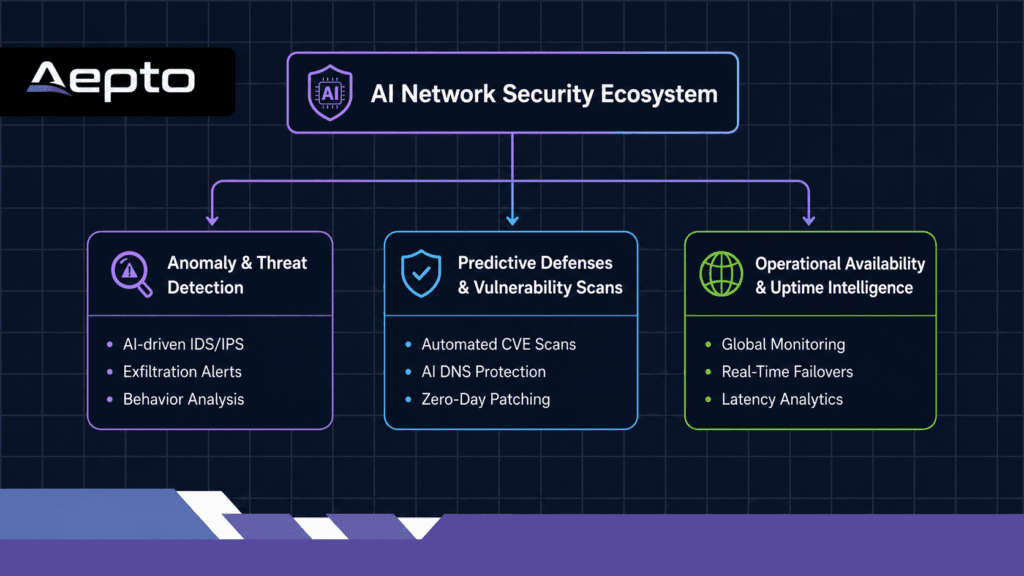
1. Anomaly Detection and Behavioral Analytics (UEBA)
User and Entity Behavior Analytics (UEBA) models establish adaptive baselines for every device, user, server, and domain on a network. The AI monitors metrics such as average data transfer volumes, connection times, geographic locations, and protocol usage.
When anomalous behavior occurs—such as a database server suddenly initiating outbound SSH connections to an unfamiliar external IP address—the AI assigns a risk score and can instantly quarantine the affected network segment.
2. Next-Generation AI Intrusion Detection Systems (IDS)
Traditional IDS tools evaluate individual network packets against static rulesets. In contrast, AI-enhanced intrusion systems process packet sequences and flow dynamics using deep neural networks (DNNs).
By analyzing the structure, frequency, and timing of incoming traffic, AI-driven detectors spot hidden command-and-control (C2) communication channels, covert DNS tunneling, and distributed denial-of-service (DDoS) staging patterns long before service interruption occurs. Learn how modern platforms deploy an AI intrusion detection system for domains to protect underlying digital assets from malicious intrusion attempts.
3. Automated Vulnerability Management and Threat Hunting
Cyber attackers continuously scan public networks for exposed ports, outdated software stacks, and unpatched vulnerabilities. AI turns this dynamic around by deploying autonomous threat-hunting models.
Rather than running periodic manual audits, automated AI systems continuously scan external and internal assets, identify misconfigurations, assess real-world exploitability, and prioritize remediation workflows based on asset criticality. Deploying an AI vulnerability scanner allows organizations to uncover zero-day security gaps across web hosts, APIs, and microservices before attackers exploit them.
Securing DNS and Domain Infrastructure with AI
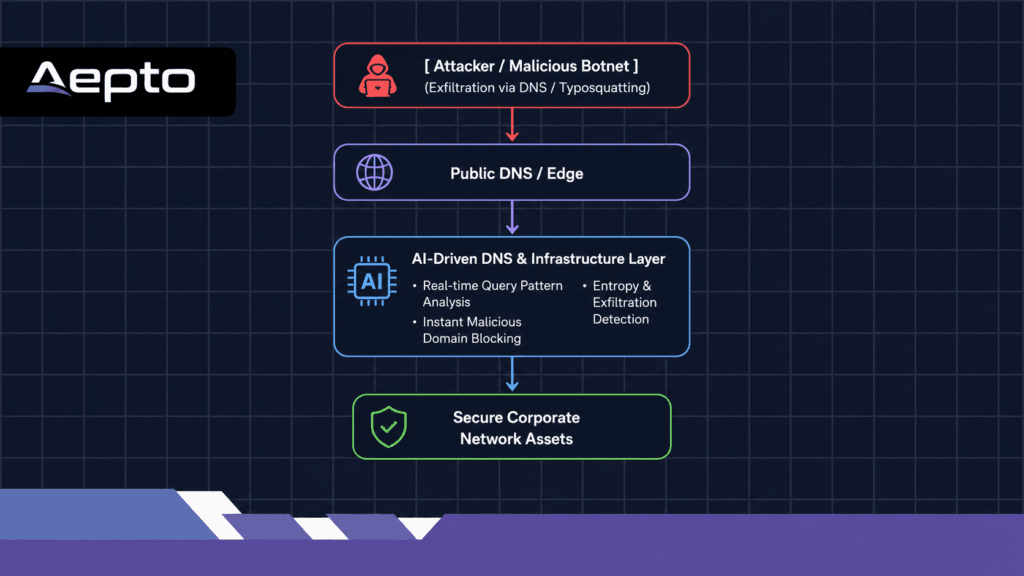
A critical yet frequently overlooked component of network security is the Domain Name System (DNS) layer. Because DNS traffic is necessary for legitimate communications, threat actors routinely exploit DNS for data exfiltration, domain squatting, malware distribution, and phishing campaigns.
Preventing DNS Tunneling and Data Exfiltration
DNS tunneling involves encapsulation of non-DNS protocols inside DNS requests (e.g., hiding stolen database records inside long TXT or CNAME record lookups). Because traditional firewalls rarely block outbound port 53 traffic, DNS tunneling often escapes notice.
AI algorithms analyze the entropy, query length, character randomness, and request velocity of DNS traffic. When an anomalous DNS request pattern is detected, the AI automatically drops the malicious packets and flags the compromised network endpoint. Implementing dedicated AI DNS protection safeguards network traffic at the core routing tier, neutralizing attacks before network perimeters are breached.
Protecting Brand Domains and Digital Perimeters
Network security extends beyond local firewall perimeters; it encompasses your organization’s entire domain portfolio. Threat actors register lookalike domains (typosquatting) to intercept employee credentials, spoof company emails, and direct users to malicious malware nodes. AI-driven monitoring systems continuously scan global registrar databases and SSL log streams to pinpoint brand impersonations in real time.
AI in Global Uptime and Performance Monitoring
Security and performance are two sides of the same operational coin. A network node that is overloaded or experiencing a DDoS attack suffers degradation that directly affects uptime and user experience.
Predictive Availability and Incident Prevention
Traditional uptime monitoring checks whether a server returns an HTTP 200 OK status code every 5 or 10 minutes. However, this reactive approach leaves systems vulnerable to hidden latency spikes, intermittent packet loss, and localized geographic outages.
AI-driven monitoring tools analyze performance data continuously across global check-nodes. By measuring minute fluctuations in TCP handshake times, SSL negotiation speed, and DNS resolution latency, AI models predict impending hardware or network bottlenecks before full outages occur. Pairing continuous security analysis with a smart global uptime monitoring platform ensures high availability, instant failover execution, and comprehensive operational visibility.
Legacy Monitoring vs. AI-Driven Security & Monitoring
To highlight how artificial intelligence transforms network administration, consider the key differences between legacy systems and AI-integrated security frameworks:
| Feature / Metric | Legacy Network Monitoring | AI-Driven Security & Monitoring |
| Detection Basis | Static signatures and hardcoded rules | Behavior baselines and ML models |
| Threat Scope | Known vulnerabilities and cataloged malware | Zero-day exploits and unknown anomalies |
| False Positive Rate | High (creates severe alert fatigue) | Very Low (context-aware risk scoring) |
| DNS & Domain Security | basic IP blocklists and manual audits | Predictive query analysis and automated DNS protection |
| Response Time | Manual triage (hours to days) | Automated isolation (milliseconds) |
| Uptime Analytics | Reactive status pinging | Predictive latency and availability forecasting |
| Scalability | Requires constant manual rule updates | Self-learning and self-optimizing system |
The Role of High-Performance Web Hosting Infrastructure
Even the most advanced AI security software relies on a secure, performant physical and cloud server foundation. When deploying AI monitoring models, web applications, or security nodes, partnering with high-grade hosting infrastructure is essential for minimizing latency and ensuring max throughput.
Modern hosting providers are increasingly baking server-side threat intelligence directly into their server environments. For instance, high-performance web hosts utilize automated firewall isolation, edge-caching, and hardware-level mitigation to shield application layers from volumetric attacks.
Understanding how AI is quietly revolutionizing online hosting infrastructure helps organizations select hosting architectures designed to support real-time data processing, low-latency API calls, and resilient system uptimes.
Best Practices for Implementing AI in Network Security
Integrating artificial intelligence into your enterprise network security stack requires careful planning, robust configuration, and strategic oversight. Follow these industry best practices to ensure seamless deployment:
1. Feed AI High-Quality, Unified Data Streams
Artificial intelligence models are only as good as the data they consume. Ensure your AI network security tools ingest telemetry from all relevant network assets, including:
- Firewall and router flow logs (NetFlow, IPFIX, sFlow)
- DNS query logs and domain registrar records
- Endpoint Detection and Response (EDR) telemetry
- SSL/TLS certificate transparency logs
- Application layer access logs and API gateway metrics
2. Implement Automated SOAR Workflows
To maximize the benefits of AI detection, pair your security engine with Security Orchestration, Automation, and Response (SOAR) playbooks. When an AI model identifies a high-confidence threat (such as an active data exfiltration attempt), the system should automatically execute pre-configured containment actions:
- Revoking compromised user credentials or API keys.
- Isolating the affected host or container from the core network segment.
- Generating a context-rich incident report for tier-3 security analysts.
- Updating border firewall rules to block malicious C2 IP addresses.
3. Maintain Human-in-the-Loop Oversight
While AI provides unparalleled processing speed, human expertise remains irreplaceable. Adopt a “human-in-the-loop” model for critical system interventions—such as shutting down production databases or redirecting core network backbones. Use AI insights to empower your security team, not replace critical human decision-making.
4. Conduct Regular Model Validation and Auditing
Threat actors actively attempt to evade AI detection through “adversarial machine learning” techniques—such as poisoning training data or obfuscating attack patterns to resemble normal traffic. Regularly audit your AI models, update baseline datasets, and subject your network defenses to periodic red-team simulation exercises.
Future Trends: What’s Next for AI in Network Security?
As we look toward the future of enterprise cybersecurity, several emerging AI trends are set to redefine how networks are monitored and defended:
- Generative AI for Threat Investigation: Security teams will interact with security consoles using natural language interfaces, querying generative AI assistants to summarize complex multi-node attack vectors instantly.
- Autonomous Self-Healing Networks: Next-generation network infrastructures will leverage AI not only to detect cyber attacks, but also to dynamically rewrite server code, apply temporary security patches, and re-route global traffic paths without human intervention.
- Quantum-Resistant AI Encryption Monitoring: As quantum computing advances, AI monitoring tools will actively inspect network traffic for cryptographic weaknesses, ensuring data streams transition smoothly to post-quantum encryption standards.
Ready to scale your Domain Monitoring?
Explore how our AI Domain Monitoring System can save you hours of manual work every week.
Conclusion
The era of relying solely on reactive firewalls, static signature files, and manual log reviews is over. As modern network environments expand across cloud clusters, edge instances, and global domain portfolios, AI for network security and monitoring has become an absolute necessity for organizations of all sizes.
By combining real-time behavioral analytics, intelligent DNS protection, automated vulnerability scanning, and global uptime intelligence, AI enables security teams to stay three steps ahead of threat actors. Implementing these intelligent tools safeguards your critical infrastructure, preserves brand integrity, and guarantees continuous availability for your users.
Take control of your organization’s digital perimeter today. Explore Aepto to discover how our cutting-edge, AI-powered domain monitoring, vulnerability scanning, and global uptime intelligence platform can fortify your digital assets against modern cyber threats.
Frequently Asked Questions (FAQs)
1. How does AI differ from traditional network monitoring software?
Traditional network monitoring tools rely on predefined rules, static thresholds, and known malware signatures to detect threats. In contrast, AI network security systems use machine learning algorithms to understand baseline network behaviors continuously. This allows AI to detect novel anomalies, zero-day exploits, and subtle attack vectors (like low-and-slow data exfiltration) that traditional systems miss.
2. Will AI network security tools replace human SOC analysts?
No. AI is designed to augment human security teams, not replace them. AI excels at processing massive data volumes, reducing alert fatigue by filtering false positives, and identifying threats in milliseconds. Human analysts are still essential for high-level threat hunting, strategic incident response, ethical judgment, and complex remediation decision-making.
3. Can AI detect zero-day vulnerabilities in network traffic?
Yes. Because AI models evaluate behavioral deviations, packet dynamics, and query structures rather than relying on known attack signatures, they can identify zero-day attacks as soon as the malicious behavior deviates from baseline network norms.
4. How does AI help prevent DNS-based attacks?
AI analyzes DNS query patterns, request volumes, entropy, and domain registration metadata in real time. It can instantly recognize indicators of DNS tunneling, fast-flux malicious networks, domain squatting, and phishing domains, allowing network firewalls to block malicious requests before data exfiltration occurs.
5. Does implementing AI network monitoring cause performance overhead or latency?
Modern AI security solutions utilize asynchronous stream processing, edge computing, and cloud-native API integrations to analyze network telemetry. This means traffic inspection happens in parallel with data transmission, introducing negligible latency to your production network.
6. Why is uptime monitoring an important component of network security?
Performance degradation and sudden downtime are often the first visible symptoms of an ongoing cyber attack—such as a Distributed Denial of Service (DDoS) attempt, unauthorized resource hijacking, or DNS hijacking. Integrating smart uptime monitoring with AI security systems allows organizations to detect latency spikes instantly and trigger automated defensive countermeasures before systems crash.
Read more:
- How Businesses Can Save Money on Domain Monitoring: A Practical Guide
- How to Use Discounts for Monitoring Multiple Websites
- What Should Businesses Monitor Besides Domain Expiration?
- Why Do Businesses Need Domain Monitoring? A Complete Guide
- AI for Network Security and Monitoring: The Comprehensive Guide