Introduction To Simplifying Domain Management Framework
In the early days of the web, managing a domain was a simple, singular task and you could easily simplify domain management according to your needs. You bought a .com, pointed it to a server, and renewed it once a year. Today, that simplicity has vanished. Modern digital ecosystems are composed of hundreds of micro-sites, campaign-specific URLs, and complex DNS configurations involving SPF, DKIM, and DMARC records.
For many agencies and IT departments, domain management has transformed from a clerical task into a high-stakes bottleneck that drains productivity and introduces significant operational risk.
By internalizing the simplification strategies in this guide, you will learn how to transition from “Reactive Management”, where you are constantly putting out fires, to “Orchestrated Management,” where your assets are governed by an intelligent, centralized system.
If you continue to manage your domains through a fragmented patchwork of spreadsheets and manual registrar logins, you aren’t just wasting time; you are inviting a catastrophic failure that could take your entire digital presence offline. This article bridges the gap between manual labor and automated intelligence, providing a roadmap to a frictionless digital portfolio.
For this guide, I have analyzed the limitations of current technical solutions, ranging from manual registrar portals to complex Infrastructure-as-Code (IaC) setups like Terraform. We have distilled these observations into a framework that prioritizes accessibility without sacrificing professional-grade security.
Simplify Domain Management?
Using an AI-powered platform like Aepto allows you to sync data from multiple registrars into one unified interface.
Why is Domain Management So Complicated?
The complexity isn’t just a result of having more domains; it’s a result of the ecosystem around them. Every time you add a new service, be it a CRM, an email marketing tool, or a security firewall, you add another layer of DNS complexity.
1. The Fragmentation Trap
Most businesses suffer from “Registrar Bloat.” Over time, domains are registered across Namecheap, GoDaddy, Google, and specialized TLD providers. Each has its own UI, its own 2FA system, and its own notification frequency. This fragmentation makes it nearly impossible to have a “Global View” of your assets.
When you can’t see all your assets in one place, you can’t protect them. This is why centralized domain management matters more than ever; without a single source of truth, the “silent expiration” of a secondary domain can go unnoticed until it becomes a PR crisis.
2. The Infrastructure-as-Code (IaC) Overhead
Some advanced teams attempt to simplify management using tools like Terraform or Pulumi. While these are powerful for “DevOps” professionals, they introduce a high barrier to entry. Managing a domain via a script requires a specialized skillset and constant maintenance of the code itself. For most agencies and business owners, this isn’t simplification, it’s just moving the complexity from the registrar to the code repository.
The Intelligence Leap: Moving Beyond Manual Checks
Simplifying your domain portfolio requires a shift in how you perceive “monitoring.” It is no longer enough to check if a site is “up.” To truly simplify, you need systems that understand the intent of your domain infrastructure.
Understanding the Logic Behind AI Monitoring
True simplification comes from automation that thinks like a sysadmin. You might wonder, how does AI domain monitoring work? Unlike traditional uptime checkers, AI monitors analyze patterns in DNS propagation, WHOIS changes, and even SSL renewal cycles to predict failures before they happen. By offloading this cognitive load to an AI, you eliminate the need for manual weekly audits.
Securing the Cloud Perimeter
As you simplify and centralize, security becomes paramount. A simplified dashboard shouldn’t just show you that a domain is active; it should show you that it is safe. Understanding the benefits of using AI in cloud security is essential for any modern business. AI can detect unauthorized “DNS shadowing” or subtle changes in your cloud environment that might indicate a breach, threats that manual management almost always misses.
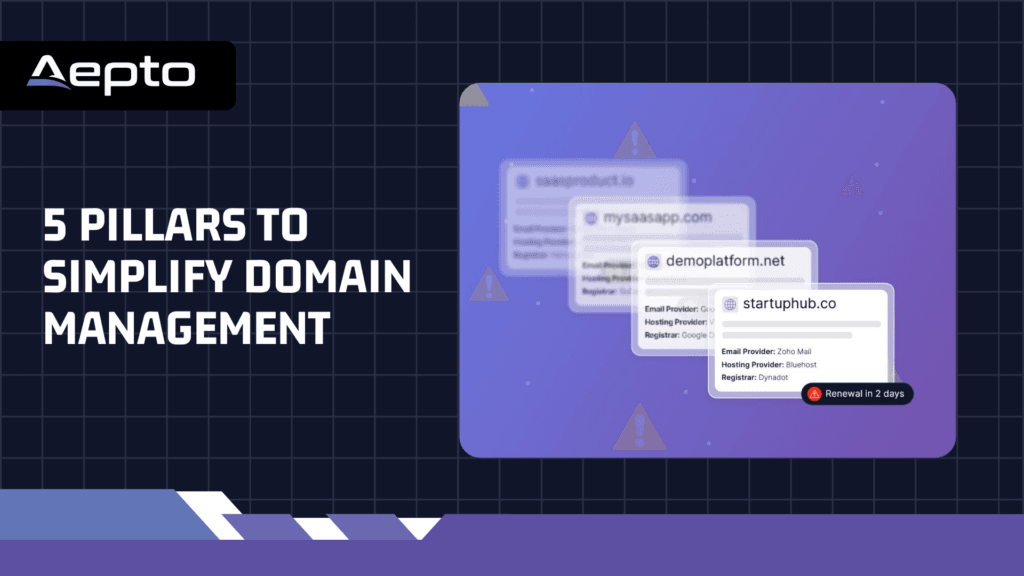
5 Pillars To Simplify Domain Management
To simplify your workflow, you must move away from manual intervention. Here is how you build a resilient, low-maintenance domain infrastructure.
1. Centralized “Single-Pane-of-Glass” Oversight
The first step to simplification is consolidation. You don’t necessarily need to move every domain to a single registrar (which can be a security risk), but you do need to view them in a single dashboard.
Using an AI-powered platform like Aepto allows you to sync data from multiple registrars into one unified interface. This eliminates the need to jump between tabs and remember different login credentials, reducing “context switching” and human error.
2. Automated Health and DNS Auditing
Simplification means having the system tell you when something is wrong, rather than you searching for problems. A simplified setup should automatically monitor:
- DNS Resolution: Are your A-records pointing to the correct IP?
- SSL Status: Is your certificate valid and properly installed?
- Mail Health: Are your MX and SPF records correctly configured?
3. Predictive Expiration Logic
Manual calendar alerts are the enemy of simplicity. A simplified management strategy uses AI to analyze your portfolio and provide a “Risk Heatmap.” Instead of a list of dates, you get an intelligent alert system that understands which domains are critical and which payment methods are nearing expiration. This is the core of how AI is changing the way we manage domains and hosting.
4. White-Label Client Management
For agencies, simplification means giving clients a professional portal where they can view their own assets without having access to your backend registrar accounts. By utilizing hosting alongside a management tool, you create a “Managed Service” model that reduces support tickets.
5. Content-Aware Asset Strategy
Simplification isn’t just about technical settings; it’s about knowing why you own a domain. Many businesses own hundreds of domains that are “hollow”, they have no content and serve no purpose. By using an AI platform monitoring tool for content gap analysis, you can see which of your domains are actually working for you and which ones can be retired, further simplifying your portfolio.
How Aepto Simplifies the Technical Burden
Aepto was built on the philosophy that you shouldn’t need a computer science degree to keep your domains safe. It acts as an “Intelligent Wrapper” around your entire domain portfolio.
From Manual Scraping to AI Discovery
Searching for new opportunities used to involve messy lists and manual WHOIS lookups. Now, you can find expired domains with AI directly within the same dashboard where you manage your active sites. This integrates the “Search,” “Purchase,” and “Monitor” phases into one fluid motion.
Real-Time Anomaly Detection
Simplicity is peace of mind. Aepto uses AI to baseline your domain’s behavior. If your nameservers change unexpectedly (a sign of a hijack), you get a notification in seconds. This allows you to focus on your business, knowing that the “Digital Perimeter” is being watched by an intelligent sentry.
[Image Placeholder: A side-by-side comparison. Left: A messy desk with 10 open browser tabs and a spreadsheet (The Old Way). Right: A clean, modern Aepto dashboard showing 100+ domains in a single, organized view (The Simplified Way).]
Infrastructure: The Silent Partner in Simplicity
You cannot have a simplified management workflow if your hosting environment is unreliable. A complex host with a confusing UI will only add to your management debt.
Why Limitless Hosting Fits the Simplified Model
At Limitless Hosting, we prioritize the “DirectAdmin” interface because it provides a clean, fast experience that doesn’t overwhelm the user. By hosting your sites on a platform that offers Budget Web Hosting with high-performance NVMe hardware, you eliminate the “Hardware Headache.”
Final Thoughts: Reclaiming Your Time
Complexity is a choice, and in the 2026 digital economy, it is an expensive one. Every hour you spend logging into different registrars or recovering an expired domain is an hour you aren’t spending growing your revenue.
The art of simplification lies in delegating the “grind” to intelligent systems. By pairing the reliability of Limitless Hosting with the automated oversight of Aepto, you are building a digital engine that runs itself. Reach out to Aepto today and experience the power of simplified management.
Detailed Frequently Asked Questions (FAQs)
1. Does simplifying management mean I should put all my domains at one registrar?
Not necessarily. While it’s easier to manage, it creates a “Single Point of Failure.” A better strategy is to keep your registrars diverse for security but use Aepto to monitor them in one place.
2. Is AI domain monitoring better than Terraform?
For most businesses, yes. Terraform requires a massive amount of manual code maintenance. AI monitoring provides the same level of oversight without requiring you to write or debug a single line of script.
3. How does simplification improve my SEO?
Search engines love stability. A simplified management system ensures your domains never expire and your SSL certificates never lapse. This maintains your rankings and authority much more effectively than manual management.
4. Can I simplify management for my clients too?
Yes. By using a centralized dashboard and Reseller Hosting, you can provide your clients with a simplified, branded view of their assets.
5. What is the first step to simplifying a messy portfolio?
Start with an audit. Connect your registrars to Aepto to see what you actually own. You’ll likely find “orphaned” domains that you are paying for but not using. Pruning these is the first step toward a lean, simple portfolio.
Read more of our posts:
- Is Domain Protection Worth It? The Definitive Guide to Safeguarding Your Digital Identity
- Corporate Domain Name Management and Renewals: The Enterprise Strategy Guide
- Multi-Domain Oversight: The Operator’s Playbook
- Free vs Paid Domain Monitoring: What Are the Differences?
- What Causes Website Downtime and How Can You Detect It Faster?