Overview: Benefits of Using AI in Cloud Security
In the current era of hyper-connected digital infrastructure, the “perimeter” as we once knew it has effectively dissolved. We no longer defend a single physical server room; we defend a sprawling, elastic cloud environment that scales up and down in seconds.
This shift has rendered traditional, rule-based security systems obsolete. If you are relying on human administrators to manually review logs and update firewall rules, you are attempting to stop a tidal wave with a bucket.
By mastering the concepts of AI-integrated security presented in this guide, you will understand how machine learning transforms cloud defense from a game of “catch-up” into a proactive, predictive shield. If you ignore the benefits of AI in cloud security, you are leaving your business exposed to automated “zero-day” threats that can compromise a network long before a human can even receive an alert. This article serves as your technical roadmap to the intelligent cloud, bridging the gap between basic encryption and enterprise-grade behavioral defense.
In the intersection of neural networks and network security, and for this analysis, I have scrutinized how AI-driven platforms like Aepto and high-performance hosts like Limitless Hosting are converging to create a safer web. We have translated these high-level cryptographic and algorithmic concepts into a tactical framework for your business.
I invite you to explore the future of cloud resilience, as the implementation of AI is no longer a luxury—it is the prerequisite for survival in the 2026 digital economy.
The Paradigm Shift: From Reactive to Predictive Defense
Traditional cloud security is “signature-based.” It looks for a known piece of malware or a known bad IP address and blocks it. The problem? Hackers create new signatures every second using automated generative scripts. AI monitoring shifts the focus from “what the threat looks like” to “how the system is behaving.”
Anomaly Detection at Absolute Scale
Cloud environments generate millions of log events per hour. A human team can only inspect a fraction of these, often missing the “low and slow” attacks that bypass traditional thresholds. AI, however, excels at “Pattern Recognition” using unsupervised learning models. It establishes a “Baseline of Normalcy” for your server.
If a user who typically logs in from London suddenly attempts to access a database from a VPN in a high-risk region at 3:00 AM, the AI recognizes the behavioral deviation. It doesn’t just look at the location; it looks at the packet size, the sequence of commands, and the typical entropy of the user’s sessions. This is fundamentally how AI is changing the way we manage domains and hosting. By automating the “sanity check” of every request, AI ensures that security doesn’t slow down the business—it enables it.
Predictive Threat Intelligence (The Pre-Emptive Strike)
AI doesn’t just watch your server; it watches the global threat landscape. By analyzing data from millions of other endpoints, the AI can predict an attack on your infrastructure before it happens. If a specific type of ransomware is spreading through a certain registrar’s network, an AI-driven monitoring tool can proactively harden your domains and hosting accounts against that specific vector.
This “Global Immune System” approach means that if one server in the world is attacked, every other server in the network learns how to defend against it in seconds. This is why why centralized domain management matters more than ever; you need a central point of intelligence to push these updates across your entire portfolio.
Ready for AI-integrated security?
Explore how our latest tools can save you hours of manual work for security every week.
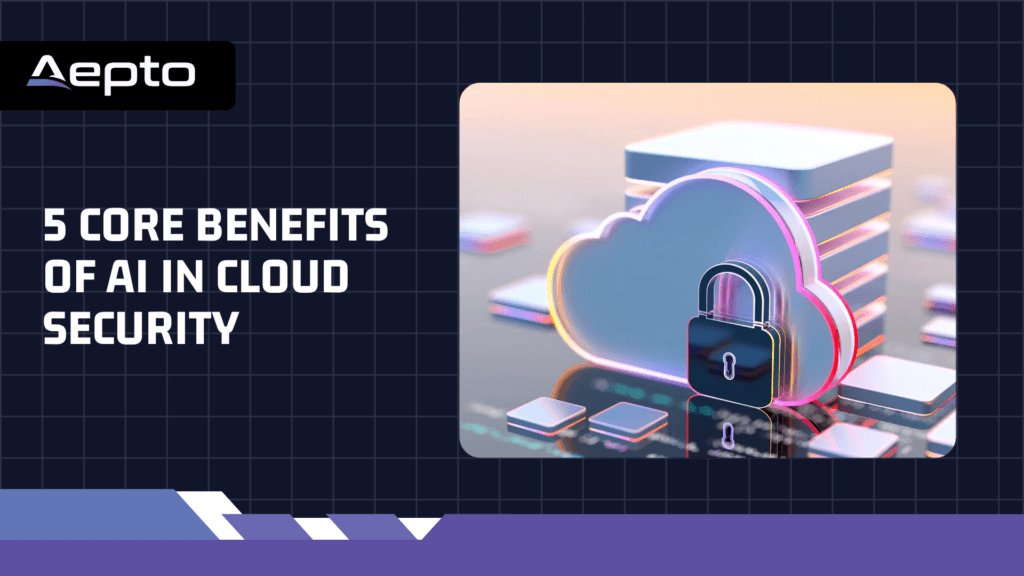
5 Core Benefits of AI in Cloud Security
To build a truly resilient infrastructure, you must leverage the specific advantages that machine learning brings to the cloud. Let’s break down the technical benefits that move the needle for modern enterprises.
1. Automated Incident Response (SOAR)
In the event of a breach, every second counts. AI-driven Security Orchestration, Automation, and Response (SOAR) can identify a breach and execute a mitigation strategy in milliseconds—long before a human admin could even read the alert email.
- Micro-Segmentation on the Fly: The AI can automatically isolate a compromised virtual machine from the network to prevent “Lateral Movement” (when hackers jump from one server to another).
- Dynamic Firewall Synthesis: Instead of static rules, the AI can write and deploy new firewall rules in real-time to block a massive, distributed DDoS attack.
- Automated Data Snapshots: The moment a threat is detected, the AI can trigger an emergency snapshot of your databases on Limitless Hosting NVMe storage, ensuring you have a clean point-of-recovery.
2. Eliminating the “False Positive” Fatigue
One of the silent killers of IT productivity is the “False Positive.” Traditional security tools often flag legitimate user activity as a threat, leading to “Alert Fatigue” where admins start ignoring notifications—eventually missing the one that matters.
AI uses “Contextual Awareness” to filter out the noise. It understands that a sudden spike in traffic might be a successful marketing campaign rather than a botnet. This allows your team to focus only on genuine risks. By integrating an AI domain monitoring approach, you can filter alerts based on asset criticality, ensuring your primary revenue-driving domains get the highest priority.
3. Securing the “Shadow” Infrastructure
In large organizations, employees often register domains or set up cloud instances without IT’s knowledge—this is “Shadow IT.” These unsecured assets often become the “Achilles’ heel” of an organization.
AI scanning tools crawl the web for any assets registered in your company’s name or linked to your IP ranges. It identifies these “orphaned” assets and brings them under the protection of your central security policy. This prevents one of the 7 common domain mistakes that cost businesses traffic and revenue—leaving an old, unpatched domain active that hackers can use as a backdoor.
4. Advanced Data Loss Prevention (DLP)
AI can “read” the data moving out of your cloud. While traditional DLP looks for patterns like credit card numbers, AI looks for intent. It can detect if an employee is downloading an unusual amount of proprietary source code or if a database is being exfiltrated in small, encrypted chunks designed to stay under the radar.
5. Identity and Access Management (IAM) Intelligence
Most cloud breaches happen due to compromised credentials. AI adds a layer of “Continuous Authentication.” Instead of just checking a password at login, it monitors the typing rhythm, mouse movements, and access patterns of a user throughout their session. If the behavior changes, the AI prompts for a multi-factor authentication (MFA) challenge immediately.
AI and Content Integrity: Preventing Brand Hijacking
Cloud security isn’t just about protecting the “server”; it’s about protecting the “brand.” Hackers often use compromised cloud accounts to host phishing pages or distribute malware using your legitimate domain names.
Real-Time Content “Fingerprinting”
AI monitoring platforms like Aepto perform high-frequency “Visual Audits” of your sites. It creates a cryptographic hash (a digital fingerprint) of your site’s structure. If a hacker manages to inject a hidden script, a malicious iframe, or a phishing form into your landing page, the AI detects the change in the site’s “Content DNA” immediately.
This level of monitoring is essential for businesses using Premium Web Hosting, where uptime and reputation are paramount. If your site starts serving malware, Google will blacklist your domain in hours, destroying your SEO rankings. AI acts as a 24/7 sentry against this “Silent Defacement.”
DNS and SSL Health Orchestration
AI manages the “plumbing” of your cloud security by monitoring the infrastructure that users never see but rely on:
- SSL Lifecycle Management: Ensuring that your Reseller Hosting clients never see a “Not Secure” warning by automating certificate renewals.
- DNS Poisoning Detection: Detecting if your traffic is being redirected at the ISP level to a malicious clone of your site.
- BGP Hijacking Alerts: Monitoring the global routing tables to ensure your IP ranges aren’t being claimed by rogue networks.
The Infrastructure Requirement: Why Your Host is the Foundation
AI security software is computationally expensive. It requires a massive amount of data processing in real-time. To implement these advanced defensive layers effectively, you need an environment that provides the raw performance required for deep packet inspection and heuristic analysis.
The Limitless Advantage
Using a high-performance provider like Limitless Hosting ensures that your security tools have the “Headroom” they need. When an AI security layer is scanning every incoming request, it requires significant CPU cycles and ultra-low-latency NVMe disk I/O.
- NVMe Speed: High-speed storage allows the AI to query log databases and threat intelligence feeds with zero lag. On slower HDD or standard SSD hosting, the security layer itself can cause site slowdowns.
- Global Network Throughput: Robust uplinks ensure that global monitoring nodes (like those used by Aepto) can check your site’s health from 50+ locations without bottlenecking your legitimate traffic.
[Image Placeholder: A technical flow-chart showing a user request passing through an AI scrubbing layer, then being verified by Aepto’s monitoring, before hitting a Limitless Hosting NVMe server.]
Detailed Frequently Asked Questions (FAQs)
1. Does AI replace the need for a human security team?
Absolutely not. AI is a “Force Multiplier.” It handles the “Grind”—the high-volume, repetitive tasks of scanning millions of logs. This frees up your human experts to focus on high-level strategy, complex forensics, and patching the architectural vulnerabilities that the AI identifies. Think of AI as the radar and the human as the pilot.
2. Can AI actually “learn” my specific business needs?
Yes. Modern machine learning uses “Transfer Learning.” It starts with a broad understanding of cloud threats and then “tunes” itself to your specific traffic patterns. Within 14 days of deployment, the AI will understand exactly what “Normal” looks like for your specific e-commerce store or SaaS platform.
3. Is AI-driven security only for large enterprises?
This is a common misconception. In fact, small businesses are now the primary targets for automated attacks because they lack 24/7 security staff. Platforms like Aepto bring enterprise-grade AI monitoring to small and medium businesses at a fraction of the cost of hiring a single security analyst.
4. How does AI security impact website performance?
If configured correctly on high-performance infrastructure like Limitless Hosting, the impact is negligible. In many cases, AI actually improves performance by blocking bot traffic and “DDoS noise” before it even reaches your web server, saving your CPU resources for real customers.
5. What is the biggest risk of using AI in security?
The biggest risk is “Adversarial AI.” Hackers are also using AI to try and “trick” security models. This is why it is vital to use a multi-layered approach. You shouldn’t rely on a single AI tool; you should combine infrastructure-level security (hosting), domain-level monitoring (Aepto), and application-level firewalls.
Final Thoughts: The Intelligent Shield
The digital landscape of 2026 is no place for static defense. We are living in an era where the threats are smarter than ever, but our defenses have finally caught up. The benefits of using AI in cloud security extend far beyond simple “protection”; they provide the predictive intelligence and automated resilience necessary to scale a business in a hostile digital world.
By combining the structural performance of Limitless Hosting with the proactive, behavioral monitoring of Aepto, you are not just hosting a website—you are deploying an intelligent, self-healing digital presence.
I encourage you to audit your security posture today. If your defense is still based on “waiting for a problem to happen,” it’s time to switch to a system that prevents the problem from ever occurring. In the cloud, the best defense isn’t a wall—it’s an immune system.
Stay secure, stay informed, and let the AI guard your perimeter so you can focus on building your empire.
Read our other posts:
- Is Domain Protection Worth It? The Definitive Guide to Safeguarding Your Digital Identity
- Corporate Domain Name Management and Renewals: The Enterprise Strategy Guide
- Multi-Domain Oversight: The Operator’s Playbook
- Free vs Paid Domain Monitoring: What Are the Differences?
- What Causes Website Downtime and How Can You Detect It Faster?