Introduction to AI’s Role in Cloud Security
The global shift to cloud computing has fundamentally rewritten the rules of modern business infrastructure. Organizations no longer maintain physical server rooms down the hall; instead, their operations span dynamic multi-cloud environments, distributed APIs, microservice architectures, and massive, serverless data lakes.
While this shift has unlocked unprecedented agility, scalability, and cost efficiency, it has also introduced a hyper-expanded, highly complex attack surface.
In this cloud-first era, traditional perimeter-based security models, such as firewalls and signature-based antivirus systems, are completely obsolete. Today’s cloud threats operate at machine speeds, exploiting ephemeral misconfigurations, compromised identities, and zero-day vulnerabilities in a fraction of a second. Human security teams are simply unable to parse the millions of security events generated by cloud logs daily, leading to alert fatigue, missed anomalies, and catastrophic data breaches.
To bridge this operational gap, enterprise defense has turned to Artificial Intelligence (AI) and Machine Learning (ML). But what is AI’s role in cloud security, and how is it transforming the way organizations protect their digital perimeter? This comprehensive guide explores the core functions of AI-driven cloud security, its real-world applications, its structural integration with modern digital assets, and how businesses can leverage AI to build an ironclad defense.
The Cloud Security Paradigm Shift
To understand why AI is necessary, we must look at the unique architectural vulnerabilities of modern cloud computing:
Ephemeral Infrastructure
In a cloud environment, resources are constantly spun up and torn down. A virtual machine or serverless function may only exist for minutes or seconds. Traditional security scanners, which run scheduled weekly or monthly audits, are completely blind to vulnerabilities within these short-lived resources.
Complex Identity and Access Management (IAM)
In the cloud, “identity” is the new perimeter. Organizations manage thousands of machine-to-machine permissions, API keys, and user roles. A single over-privileged user account or an unrotated access key can expose an entire database to the public internet.
Multi-Tenant Resource Sharing & Kernel Weaknesses
Public clouds run on shared physical hardware. While hypervisors enforce strict isolation, sophisticated kernel-level vulnerabilities frequently threaten these boundaries.
The catastrophic potential of these weaknesses has been starkly demonstrated by a wave of critical Linux kernel exploits: Copy Fail (CVE-2026-31431), Dirty Frag, and the zero-race Fragnesia (CVE-2026-46300) vulnerability. These vulnerabilities allow local, unprivileged attackers to break kernel-level access controls and escalate their privileges to root with 100% reliability. In a multi-tenant cloud environment, a breach of one tenant’s containers can allow an attacker to leverage a kernel zero-day to compromise the host kernel itself, bypassing hypervisor isolation and gaining access to neighboring server volumes.
Because of this speed and complexity, manual configuration monitoring is a recipe for failure. Modern security requires an autonomous, intelligent system that continuously analyzes system states and acts dynamically. To discover the foundational advantages of this approach, read our dedicated piece on the benefits of using AI in cloud security.
Defining AI’s Role: The Cognitive Defense Engine
At its core, the role of AI in cloud security is to act as a cognitive defense engine, a system capable of observing, learning, predicting, and acting at a scale and speed that is humanly impossible. AI does not replace human security analysts; instead, it supercharges their capabilities by handling the heavy analytical lifting.
[ Raw Cloud Logs ] ➔ [ AI Behavioral Engine ] ➔ [ Anomaly Detection ] ➔ [ Automated Orchestrated Response ]
Continuous Behavioral Baselines
Unlike legacy security tools that rely on pre-defined lists of known bad signatures, AI uses unsupervised machine learning to establish a baseline of “normal” behavior for your entire cloud ecosystem. The AI continuously analyzes:
- Normal user login times, locations, and device types.
- Standard data transfer volumes between cloud buckets.
- Regular API call sequences and resource provisioning.
Once the baseline is established, any deviation, such as an administrator account suddenly downloading gigabytes of databases from an unusual IP, is instantly flagged as a potential breach.
Reducing Noise and Alert Fatigue
A major bottleneck for enterprise Security Operations Centers (SOCs) is the sheer volume of alerts. When security tools scream “red alert” for minor configuration warnings, analysts experience alert fatigue, leading to real, critical attacks being ignored. AI algorithms sort through the white noise, prioritizing and correlating minor alerts into a single, cohesive “attack chain,” allowing teams to focus on actual threats.
Utilize AI-Driven Website & Content Monitoring
Deploy intelligent crawlers that “read” your web pages, compare them to historical baselines, and detect malicious alterations.
Core Applications of AI in Cloud Security
AI has moved beyond academic theory; it is now deeply integrated into the runtime of modern enterprise clouds. Here are the core areas where AI is making the biggest impact.
A. Cloud Security Posture Management (CSPM)
Misconfiguration is the leading cause of cloud breaches. AI-driven CSPMs continuously scan cloud configurations (such as AWS S3 buckets, Azure SQL databases, and Kubernetes clusters) to find open ports, unencrypted storage, or over-privileged roles. Instead of just flagging the issue, advanced AI systems use natural language processing (NLP) to write auto-remediation scripts, fixing the security gap automatically before it can be exploited.
B. Intelligent Identity Threat Detection (ITDR)
Identity-based attacks are highly sophisticated. When an attacker steals a legitimate employee’s credential, they do not trigger a traditional firewall. AI monitors identity behavior to detect “impossible travel” (logging in from London and Tokyo within an hour) or anomalous privilege escalations, cutting off compromised sessions in real-time.
C. Advanced Predictive Threat Hunting & Exploit Defense
AI models ingest global threat feeds, forums, and dark web data to predict where attackers are likely to strike next. This predictive modeling is the only way to defend against advanced techniques seen in vulnerabilities like Dirty Frag.
Because Fragnesia manipulates the in-memory page cache of read-only files (such as /usr/bin/su) rather than modifying the files on disk, traditional file integrity monitoring (FIM) and signature-based antivirus scanners are completely blind to the attack. AI-driven security platforms solve this by using behavioral heuristic models to monitor active memory allocations, timing inconsistencies in process termination paths (identifying the do_exit() race condition), and unauthorized system calls (like malicious uses of pidfd_getfd(2)).
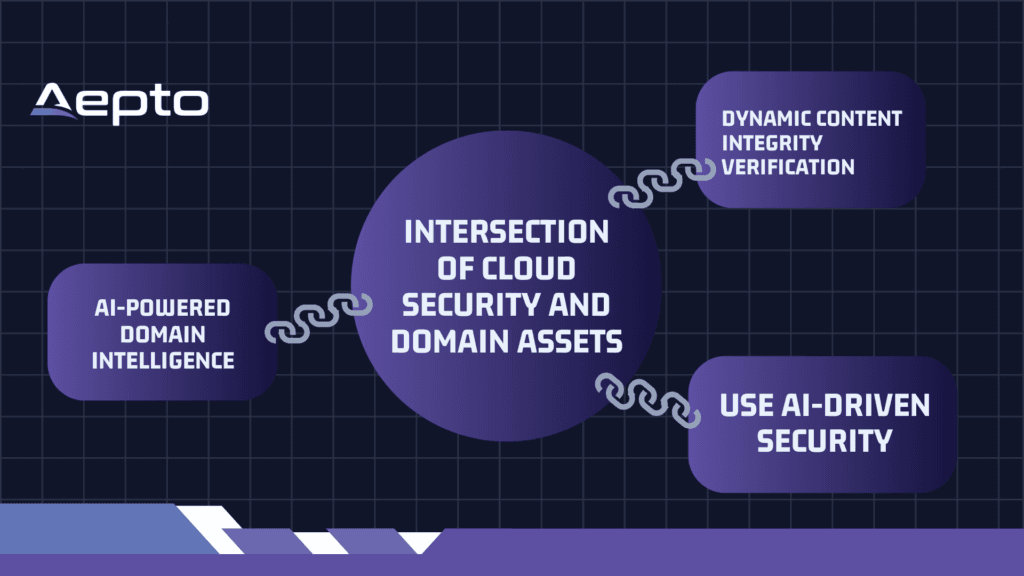
The Intersection of Cloud Security and Domain Assets
A cloud environment is only as secure as the avenues of entry leading to it. Your domain name is the ultimate point of access for your cloud applications. If an attacker hijacks your domain or manipulates your DNS settings, they can redirect your clean cloud traffic to malicious lookalike servers, intercepting customer credentials, API tokens, and corporate data.
Therefore, true cloud resilience must pair deep server-side AI with intelligent domain perimeter defense.
AI-Powered Domain Intelligence
To secure this boundary, enterprise cloud administrators use AI-powered smart domain insights. By analyzing registry data, WHOIS changes, and network patterns at scale, AI can identify indicators of domain hijacking, unauthorized registrar transfers, or DNS spoofing before they impact your cloud traffic.
Dynamic Content Integrity Verification
Furthermore, attackers who breach a cloud-hosted application often inject subtle, malicious code into your website’s header or scripts to steal credit card data (Magecart attacks) while leaving the server apparently running fine. Traditional uptime monitors miss this entirely.
By utilizing AI-driven website content monitoring, you can deploy intelligent crawlers that “read” your web pages, compare them to historical baselines, and detect malicious alterations instantly. This dynamic defense layer is discussed extensively in our comprehensive AI domain monitoring guide.
Security Synergies: Infrastructure and AI Monitoring
For cloud applications to operate safely, the relationship between your software security intelligence and your underlying web hosting infrastructure must be completely seamless. You cannot run advanced AI security engines on brittle, slow, or poorly maintained hardware.
While Aepto monitors your domain health, registry statuses, and DNS changes, a fast, SSD-powered hosting infrastructure ensures that your core databases, web panels, and user sessions are fully isolated from multi-tenant security risks.
When your hosting infrastructure is fast, secure, and actively patched against vulnerabilities like Copy Fail or Dirty Frag, your cloud-hosted AI algorithms can query databases and analyze logs without causing performance bottlenecks. This synergy prevents security measures from degrading the user experience, proving that performance and high-grade safety must always go hand-in-hand.
Real-World AI Security Workflows
| Defensive Phase | Traditional Method | AI-Driven Method | Aepto Advantage |
|---|---|---|---|
| Vulnerability Scanning | Scheduled monthly audits | Real-time continuous analysis | Spot instant DNS & configuration drifts |
| Intrusion Detection | Hardcoded IP/country blocks | Deep behavioral profiling | Detect subtle privilege escalations |
| Malware Mitigation | File signature checks | Exploit payload heuristics | Catch zero-day alterations (like page-cache manipulation) |
| Alert Management | Raw, un-grouped log lists | Automated threat correlation | Group micro-events into single, clear alerts |
Step 1: Active Ingestion
The AI system ingests gigabytes of telemetry data, including cloud provider logs (like AWS CloudTrail), network flow logs, and external domain registry updates.
Step 2: Contextual Analysis
Instead of treating events in isolation, the AI correlates them. A minor configuration change in your DNS, combined with a login from an unverified VPN, and an attempted privilege escalation utilizing a known kernel-race window is combined into a single, high-priority incident.
Step 3: Orchestrated Isolation
If the risk score crosses a set threshold, the AI triggers an automated playbook:
- Disabling the affected API key.
- Forcing a re-authentication challenge to the user.
- Instantly executing a cache-flush command (
echo 3 > /proc/sys/vm/drop_caches) to clear any malicious memory-based payloads injected via Fragnesia. - Notifying the security response team via instant messaging.
Challenges and the Future of AI in Cloud Security
While AI is a powerful ally, it is not a silver bullet. Organizations must navigate several technical challenges to use it effectively.
The Rise of Adversarial AI
Cybercriminals also have access to advanced AI models. Attackers are currently using machine learning to write polymorphic malware (which changes its signature with every file generation) and automate their scanning processes to spot cloud misconfigurations within seconds of exposure. Security is a continuous, AI-versus-AI arms race.
Mitigating False Positives
If an AI system is tuned too aggressively, it will flag legitimate developer actions as malicious, slowing down product deployment and frustrating internal teams. Tuning machine learning models to accurately understand the nuances of your unique development cycle is a critical, ongoing task for modern sysadmins.
Conclusion: Securing Your Legacy with AI
The cloud is too fast, too large, and too complex for manual security management. AI has transitioned from an optional enhancement to a mandatory pillar of enterprise cloud defense. By continuously learning behavioral baselines, weeding out the white noise of false alerts, and automating incident responses, AI allows companies to operate securely in hostile digital environments.
Protecting this cloud architecture requires securing every entry point, starting with your domain name. By pairing robust server hosts with Aepto’s advanced domain-intelligence models, you build a multi-layered shield that protects your brand from the registry to the runtime.
Ready to secure your digital presence? Open your Aepto Dashboard today to audit your domain health, activate real-time watching, and leverage the power of automated threat detection.
Frequently Asked Questions (FAQs)
1. Does AI completely replace human security teams?
No. The role of AI is to automate repetitive, data-heavy analytical tasks, such as sorting logs and identifying anomalous patterns. Human intervention remains absolutely critical for high-level threat investigation, strategic planning, policy creation, and final incident response decisions.
2. How can AI prevent misconfigurations in the cloud?
AI-powered Cloud Security Posture Management (CSPM) tools continuously scan your cloud architecture against industry security baselines. If a developer accidentally opens an unsecured database or exposes an API gateway, the AI instantly flags the error and can automatically run remediation scripts to lock down the resource.
3. What is the difference between signature-based and AI-based detection?
Signature-based detection looks for exact matches of previously identified malware files. If the malware is slightly modified or is a zero-day exploit, signature scanners are blind to it. AI-based detection ignores signatures entirely, focusing instead on system behaviors, allowing it to catch completely new, unclassified attack styles (like the memory-resident payload of Fragnesia) in real-time.
4. How does domain hijacking impact cloud security?
Your domain points users to your cloud applications. If an attacker gains access to your domain registry or modifies your DNS, they can hijack your traffic. Even if your cloud servers are 100% secure, users will be redirected to malicious spoofed servers, exposing critical credentials. Monitoring this boundary with Aepto is essential for holistic cloud defense.
5. Why is high-performance web hosting critical for security tools?
Security plugins, logs, and real-time scanning tools require significant CPU and RAM resources. Running your systems on high-performance providers like Limitless Hosting prevents your web applications from lagging or crashing while security protocols are being processed.
6. Can AI tools defend against kernel vulnerabilities like Copy Fail, Dirty Frag, and Fragnesia?
Yes. While the vulnerability itself must be patched via kernel updates, AI defense platforms can detect post-exploitation attempts. By monitoring for anomalous user elevations, unexpected page-cache changes, or unauthorized system calls like pidfd_getfd(2), AI can quarantine compromised processes and drop system memory caches automatically to neutralize the exploit mid-attack.
Read more of our blogs: